DCPA NEWS CENTER
Enjoy the best stories and perspectives from the theatre world today.

 Anthropology in the simplest sense is the study of human society — anthropos is from the Greek meaning human or mankind and logos meaning science. It can be the study of ancient civilizations or of a specific group of people in a distant part of the world who are removed from Western society. Anthropology is often associated with the study of “exotic” or far-flung societies in rural parts of the globe. But ultimately, the insights anthropologists have gathered demonstrate just how much all human societies share. For example, we all have notions of the sacred; we all have a conception of family and nurture dreams and aspirations for the future. We all think about intergenerational tensions, and we all share resources — sometimes better than others. These basic questions of economy, religion, and family are shared from one society to another. Maybe the best definition of anthropology is to understand the discrepancy between how people talk about a society and how that society is organized (for instance, in matters of economy or politics): The role of an anthropologist is to understand and expose tensions between that perception and reality.
My role on the show initially began as a researcher, helping the director and the performers understand the world of Tulsa 1967, in which the novel is set. In this iteration of the play, there is also diverse casting — especially in terms of the Greasers. Many of those people were part of Tulsa in 1967; they just weren’t necessarily highlighted in S.E. Hinton’s novel. Part of my job was to help everyone think through what the experience of different characters who belong to different ethnic or racial groups might have been like in that moment and to help the performers better understand the tensions their characters are trying to navigate.
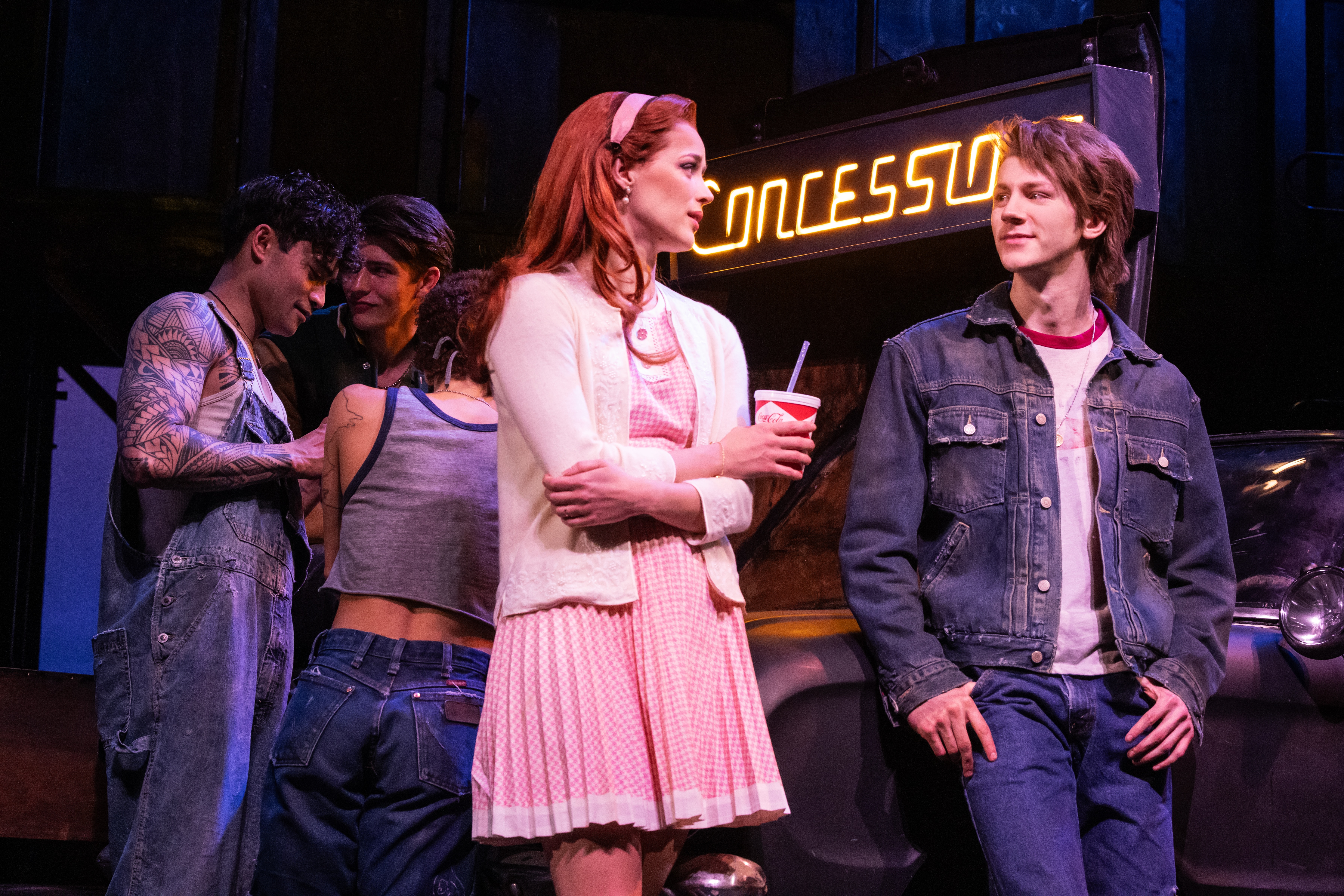
Emma Pittman and Brody Grant. Photo: © 2024, Matthew Murphy
In the early 20th century, Tulsa was a huge oil center. There were wealthy families who made even more money through their investment in oil and other families who never had before known that kind of wealth. A broad range of people built and fortified the oil industry infrastructure, like mechanics, engineers, and other technicians. By 1967, there was a question of just how much longer the oil money was going to continue and whether Tulsa would continue to hold its place in the broader economic landscape. You can see that dynamic in The Outsiders. The Socs are wealthier, more privileged, more well-connected, and the Greasers seem to be more marginal, low-income. The group with privilege is fiercely defending their privilege without knowing how much longer it is going to last.
Tulsa in 1967, like much of the US, was racially stratified, but there was also evidence of racial transformation and change in that moment. There were a lot of firsts around that time for African Americans in Tulsa — the hospital system was desegregated that year and influential doctors like Charles James Bate would finally serve the general public. Charles L. Owen became the first black judge in Oklahoma the following year. There were also major historic events like the Civil Rights Act of 1964, the Voting Rights Act of 1965, as well as the assassinations of John F. Kennedy, Robert F. Kennedy and Martin Luther King, Jr, all of which took place around the time that this story was written. These were major events in America with huge political ramifications, and our characters are inhabiting this world as they are also navigating the more specific and immediate tensions and crises associated with high school and coming of age. By casting in a more diverse way, the play captures something that was not explicit in the book — this time of transformation — and allows us to talk both about the specifics of the story and the context at the same time.
The other thing to note is that there was also a very strong indigenous presence in Oklahoma in the 20th century. In 1967, local newspapers reported that the will of an Osage princess was being contested, which is a reminder that diverse groups of people had access to wealth and influence including Osage and Cherokee leaders. The indigenous presence has always been substantial in this region even if they have not always controlled formal sectors of society.
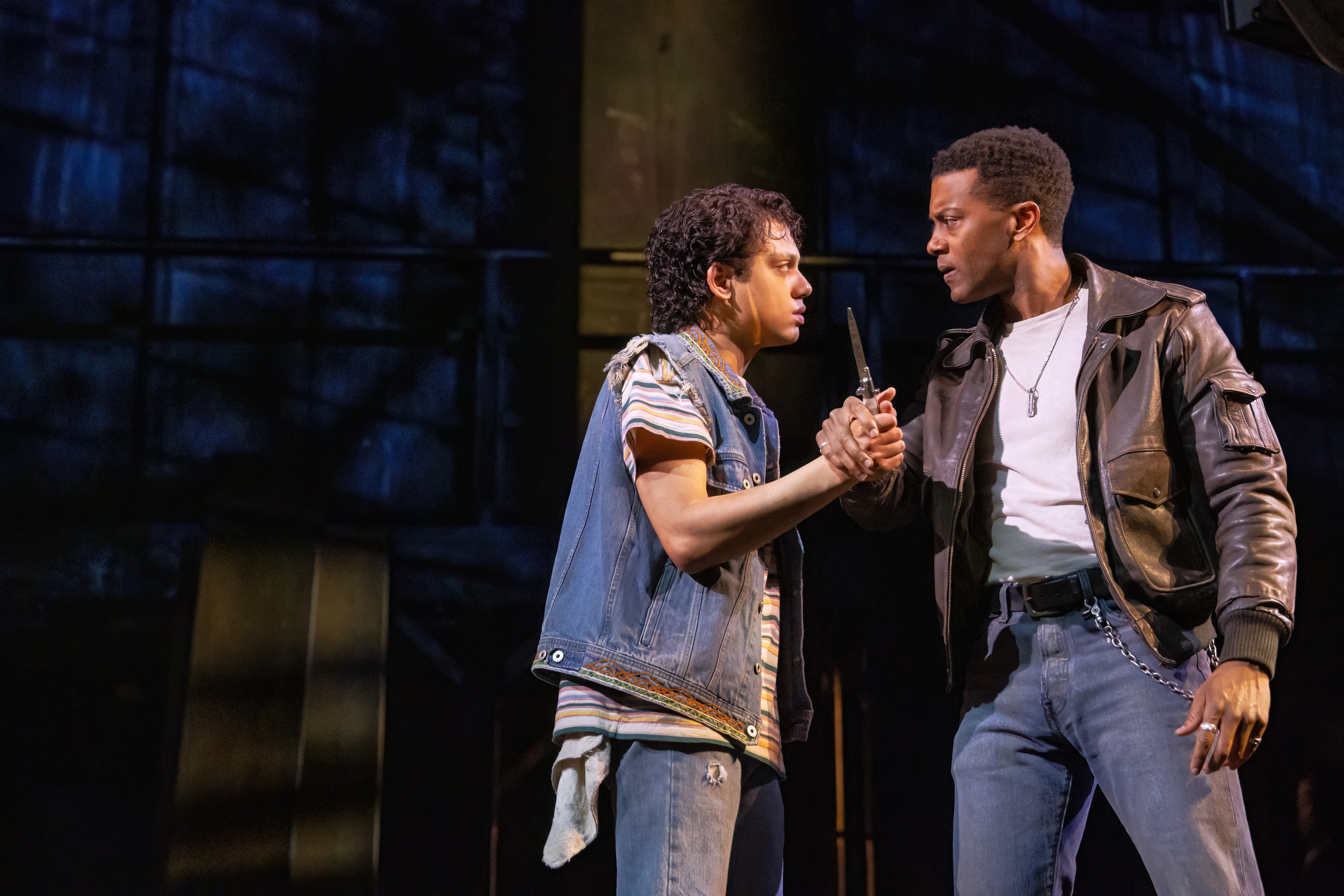
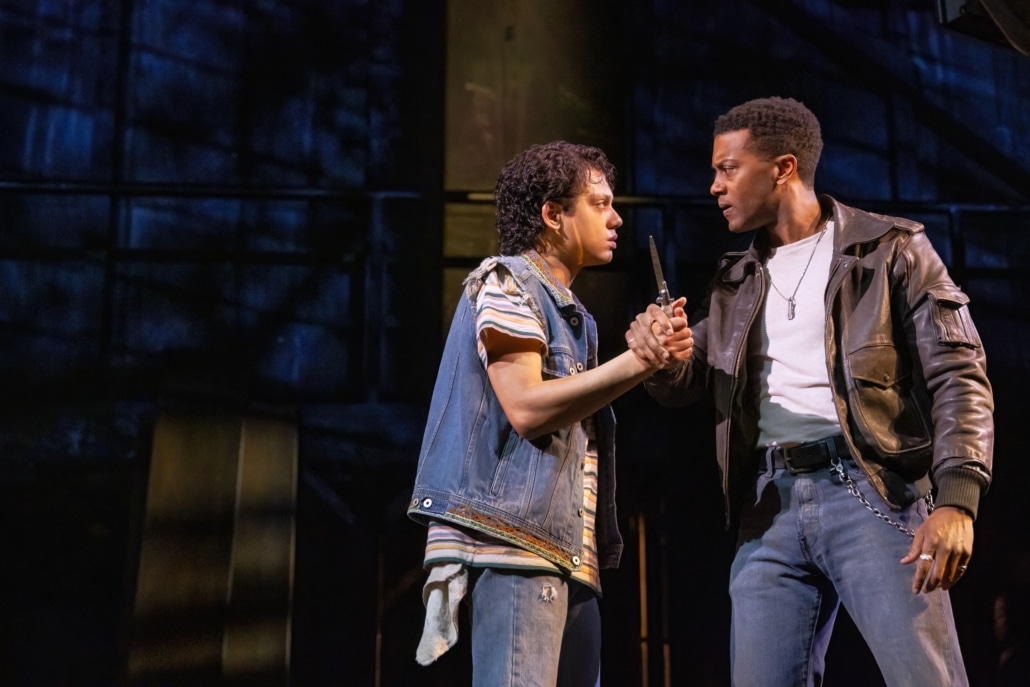
Sky Lakota-Lynch and Joshua Boone. Photo: © 2024, Matthew Murphy
Let’s take the character of Dally. In the novel, it is mentioned he has lived in New York and has had encounters with the criminal legal system; but then, in the casting of the musical, an African American man plays the role. That casting resonates with the present era of mass incarceration and news stories about police killings of unarmed African Americans. There has been a lot of attention paid to what it means to have performers from different racial backgrounds play specific roles. We do not want to traffic in stereotypes and reproduce harm, but we do want to make sure the play is available for tough conversations. For the play to have pedagogic purpose and provide insight about our society, it has to feel authentic and resonate with the world around us. There have been tough conversations amongst the writers and directors, producers, and performers, about specific dialogue and specific events in both the original story and the musical — and about how to make sure we approach these themes with a lot of care and nuance.
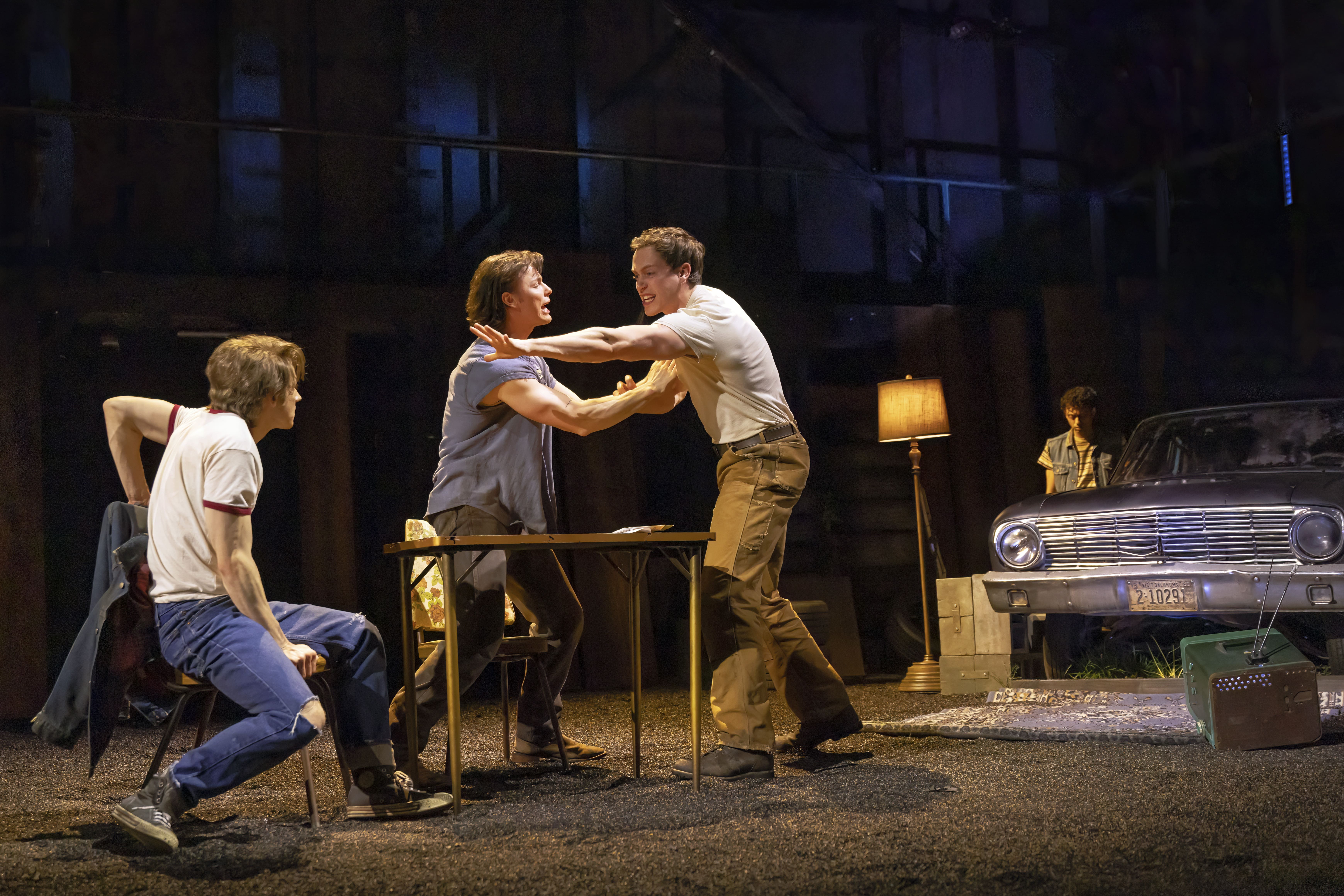
Brody Grant, Jason Schmidt, Brent Comer, Sky Lakota-Lynch. Photo: © 2024, Matthew Murphy
On the surface, it looks like the Socs have these wonderful lives and the Greasers are struggling; but actually, the Greasers are very tight-knit, and they have a lot of attentiveness and care in their family structure even if it is untraditional. Alternatively, you see a lot of anxiety and alienation amongst the Socs, even though they have more resources. The story of the Greasers is one of family, camaraderie, and care, but there is no doubt that the stress and tensions of struggle show up in the Greasers sociality. They have a lot of tense conversations, violence is routine—whether they are fighting off the Socs or even amongst themselves. The Greasers have non-normative views about how to socialize; it is rougher than normal, because they live rougher lives. But what holds them together is their care and appreciation for one another. Some of this comes from necessity. We do not see much about their home lives. We just know that they seem to have a lot of time to themselves. They seem not to have a lot of people who are keeping tabs on them or trying to account for their whereabouts or their well-being; these dynamics suggest that either their parents are absent or perhaps busy working multiple jobs and juggling multiple priorities.
I observe some parallels between the Greasers and skateboarders of today. You see the same kind of camaraderie, care, and rebellion. They are a subculture unto themselves that people outside of their group do not always understand. Or, consider the fact that what might be called a gang is just a group of young people who don’t really fit in anywhere sticking together. On the flip side, shows like “Gossip Girl” or “Laguna Beach” resonates with the Socs. The characters all go to elite schools, and they are privileged, but they still get into trouble. An interesting shift from 1967 to now is the rise in Black elites, who are well-connected and influential. So, while in the book the Socs are all white, now there are other ethnicities of elites. Stacy Dash’s character Dionne Davenport in Clueless is African Americanbut nonetheless is a Soc, in that sense.
Whether we are talking about skateboarders, nerds, jocks, or socialites, we can see that people often have fears and anxieties about what it means to allow others in. In the context of wealthy elites, we have the added dimension of banding together to protect resources and influence. There are all kinds of ways in which privilege gets inscribed and reinscribed, and we get these forms of inequality despite people’s best intentions — despite knowing the lessons of history. There are a lot of parallels about where wealth and privilege get concentrated, and how there are forms of exclusion. For every era and every generation, we need to learn to break down and dissect those forms of exclusion or else we will simply reinscribe them.
This article originally appeared in The Outsiders study guide.
READ MORE
The Denver Center for the Performing Arts (DCPA) NewsCenter is the organization’s editorial platform for stories, announcements, interviews, and coverage of theatre and cultural programming in Colorado. We are committed to producing accurate, trustworthy, clearly sourced journalism that reflects our mission and serves our community.