DCPA NEWS CENTER
Enjoy the best stories and perspectives from the theatre world today.

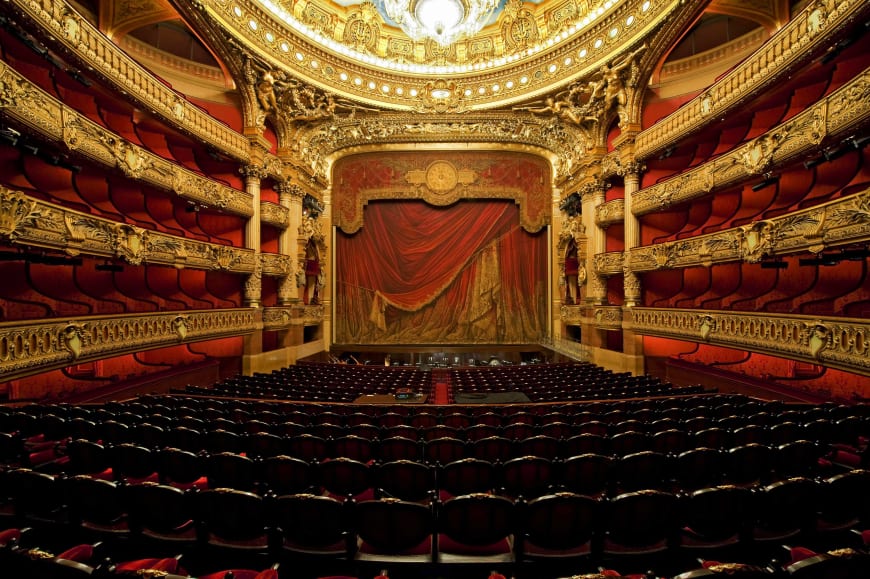
Palais Garnier, Paris
Two incredible theatrical events took place in 1861. In Paris, France, construction started on the Palais Garnier, destined to become perhaps the most famous and elegant opera house in the world and the magical setting for Gaston Leroux’s Gothic horror novel, The Phantom of the Opera.
Meanwhile, 7,850 kilometers away on the high plains of Colorado in the boom town of Denver, the same year saw the opening of the Platte Valley Theatre, the first theatre in town that was adjacent to a saloon, rather than in it. Denver’s previous theatre, the Apollo, was located on the second story of a saloon, with disasterous results. Rocky Mountain News editor William Byers panned the theatre’s audience, writing, “The conduct and language of the few rowdies in the gallery were most shameful. None but the most brutal instincts would have prompted such indecent and riotous exhibitions.”
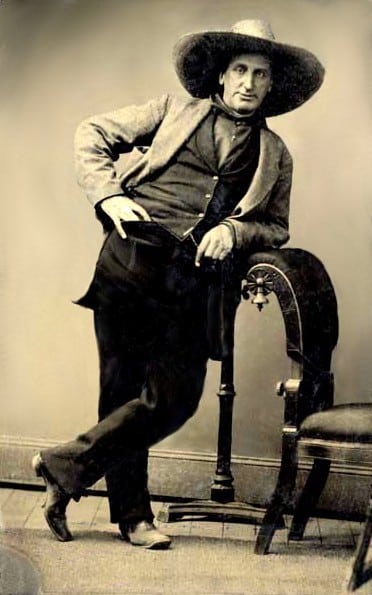
Jack Langrishe
The new two-story wood building theater located at the northeast corner of 16th and Lawrence streets was different than the Apollo and opened with a production of Shakespeare’s Richard III. In 1862, when it was taken over and renamed The Denver Theatre by an affable Irishman named Jack Langrishe, the theatre immediately instituted a new strict rule. No swearing!
Though classical plays were performed in The Denver Theatre, the audience preference was for melodrama, low comedy, and farce such as The Drunkard, His Last Legs, Why Won’t She Marry?, Hole in the Wall, Dead Shot, Pikes Peak Gold Fiend, and Uncle Pat’s Cabin. It was in the later production that when the actress took sick, Jack Langrishe played the female role, much to the delight of the crowd.
Langrishe began his acting career at age 15 in Dublin and worked in the theatre in New York before forming and transporting an acting company to the Wild West where he would become the “Father of Western Theatre,” producing, directing, writing and acting in plays in frontier mining towns until he retired from the stage in 1885. He played many roles but was best loved as a comedian. The Rocky Mountain News reported his “homely mug” drew “salvos of applause whenever it appeared behind the footlights.”
Tickets to the theater were one dollar that could be paid in cash, gold dust, eggs and even vegetables. Among notable events in the theatre were the occasion when they produced the locally written Pat Casey and His Night Hands, a farce that made fun of local successful miner Pat Casey. Outraged, Pat Casey told them to stop the production or he and his hands would come down and “shoot ’em up.” Langrishe was not bothered. He continued the production and gave away the first five rows of seats — to the troops of the local militia.
Then there was a horrific turn of events in 1864. Alarmed by attacks of Cheyenne Dog Soldiers on outlying settlements, Colorado Territorial Governor John Evans issued a proclamation authorizing the citizens of Colorado “to kill and destroy, as enemies of the country…all hostile Indians.” In this terrorized atmosphere, Colonel Chivington led Colorado troops to attack an Indian encampment at Sand Creek and afterward appeared at The Denver Theatre to celebrate the “victory.” It was only later revealed that the “battle” was in fact a massacre where 230 innocent Cheyenne and Arapaho, mostly women, children and the elderly, were killed despite being camped where they had been instructed by the army.
Another event for local audiences occurred on Dec. 8 and 9, 1864 when a snowbound couple, singers “Mr. and Mrs. Gruenwald, recently employed at Thomas Maguire’s Opera House in San Francisco,” provided Denver with its first operatic experience of record. Notably, there was no review of the occasion.
Langrishe and his actress wife, Jeannette, were immensely popular in Denver and brought great respectability to the theatre and its actors. Jeannette was described by a contemporary as “a fat, frowsy woman — and her voice was as coarse as any I’ve ever heard issuing from a feminine throat.” This made her frequent casting as an ingenue problematic; however, Denver audiences were forgiving. But by 1871, gold mining near Denver was on a decline and Langrishe and his troupe moved on to Chicago and then on to the mining boom camp of Deadwood, South Dakota, where they were so popular, they opened three theaters. Langrishe appears as a character (not a very historic one) in the TV series “Deadwood.”
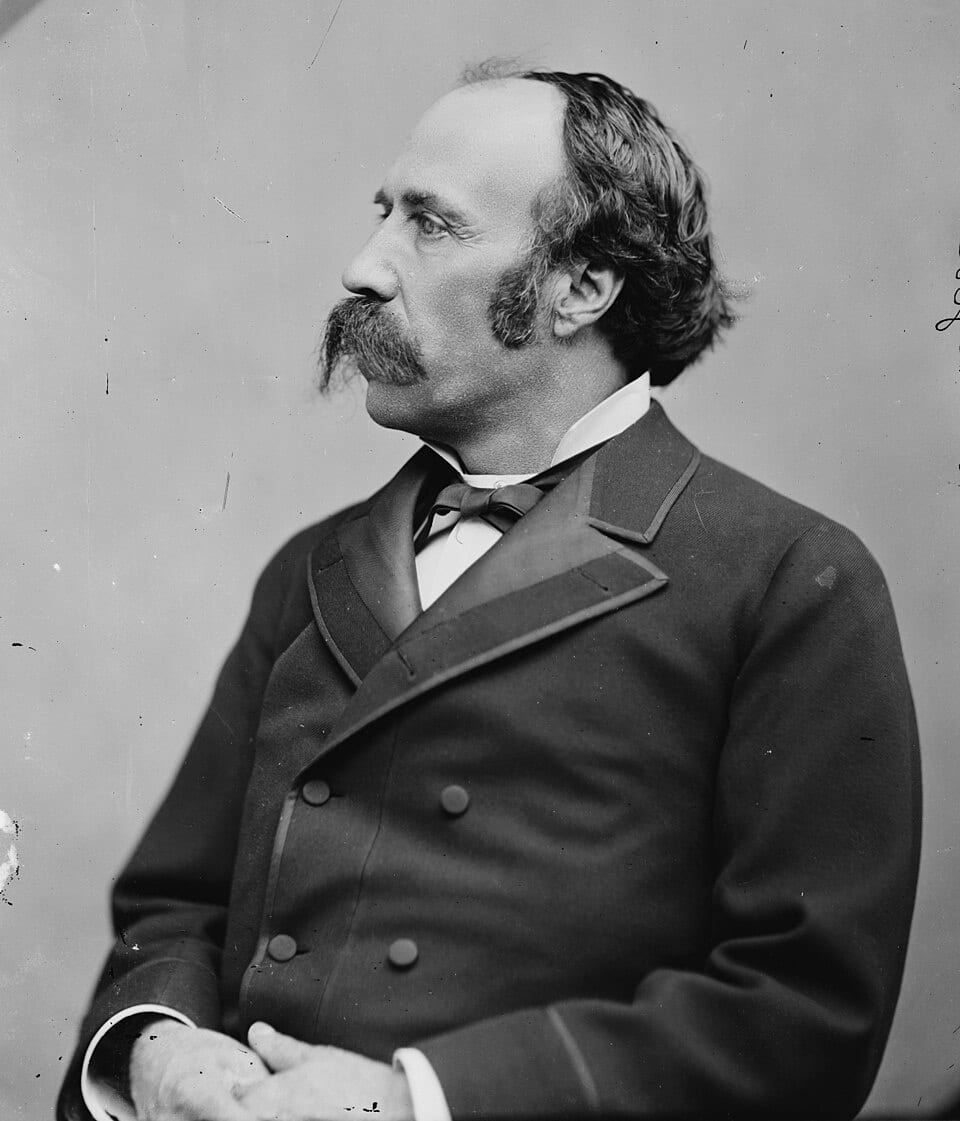
Horace Tabor
By this time back in Colorado, a new theatre producer was on the scene, this one a grocer named Horace Tabor who had the good fortune to grubstake a prospector and in so doing became the richest man in the state. In 1878 in the mining town of Leadville, the newly rich grocer built the $65,000 Tabor Opera House (valued as much as $2.5 million today), the finest theatre in this part of the West with 880 scarlet plush seats with gold and white décor. And he hired Langrishe to come back and run it! The gala opening was a success, marred only by the double lynching in town that took place the same night.
Tabor Grand Opera House, Denver
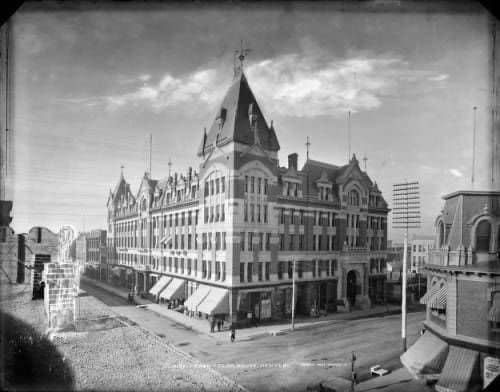
Eventually, both Langrishe and Tabor moved on to Colorado’s largest city, Denver, and in 1881 (the year in which The Phantom of the Opera takes place) Tabor and his architect, W. J. Edbrooke opened the Tabor Grand Opera House at 16th and Curtis. No expense was spared. Edbrooke (who also later designed the Brown Palace Hotel) imported cherrywood from Japan, mahogany from Honduras, and paintings from Europe to adorn the interior. The total cost of the multi-story, 1,500-seat, block-long opera house was said to $850,000, a fortune in its day (valued at nearly $30 million today). Befitting its stature, opening night featured America’s most popular prima donna, Emma Abbott, and her Grand English Opera Company. Her fee alone was $20,000, plus $3,070 for railroad fare.
For a while, the Tabor Grand was an outstanding success. Langrishe occasionally performed there before losing interest in the theatre and retiring to Wardner, Idaho, where he edited a newspaper and became an elected state senator. He died in1895.
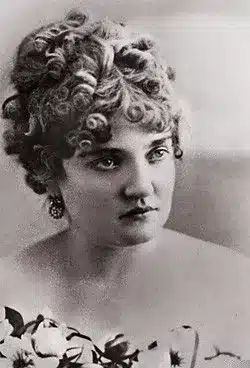
Elizabeth McCourt (Baby Doe)
For Tabor, much like most of his life, ruin was just around the corner. Tabor had scandalously (for the times) divorced his wife Agusta and married his mistress, Elizabeth McCourt, known as Baby Doe. Though happy in marriage, Horace and Baby Doe spent their fortune recklessly and when the silver market crashed in 1893, they fell into poverty. Horace died in 1899; his last advice to Baby Doe was to foolishly hold on to the Matchless Mine, which he predicted would produce silver once again. He was wrong. Baby Doe lived in a cabin next to the mine in abject proverty, newspapers wrapped around her feet for warmth. In 1935, she was found alone, frozen to death. If the story sounds like an opera, it became one: The Ballad of Baby Doe by American composer Douglas Moore.
The Denver Theatre burned to the ground in 1879. The Tabor Grand Opera House was sold and eventually became a grind movie house before being torn down as an eyesore in 1964.
Somehow, Tabor seemed to sense all this. The inscription he had placed on the curtain of the Tabor Grand read:
So fleet the works of men,
Back to the earth again;
Ancient and holy things
Fade like a dream.