DCPA NEWS CENTER
Enjoy the best stories and perspectives from the theatre world today.


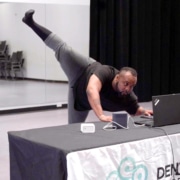
DCPA Head of Acting Timothy McCracken teaches a group of young professionals a class in Public Speaking in the Randy Weeks Conservatory Theatre. Photo by John Moore.
Speaking outdoors or to a large group can be challenging, and not just because of the nerves. Without meaning to, speakers often push their voices to be heard, leading to strain, fatigue, and disconnection from the audience.
 According to Allison Watrous, Executive Director of Education and Community Engagement at the Denver Center for the Performing Arts (DCPA), the key to vocal support isn’t speaking louder, it’s speaking smarter. Borrowing tools from the stage, the DCPA’s corporate training helps professionals lead, speak, and present with confidence.
“Theatre is fundamentally about communication and relationship,” Watrous says. “Public speaking is the same skill set, just in a different setting.”
Drawing on professional actor training and years of coaching business leaders, she shares five essential tips to help speakers communicate with clarity and care for their voice.
In theatre, breath is the foundation of sound. Actors rely on deep, supported breathing to sustain their voices across large spaces, sometimes for eight shows a week.
“When people get nervous, their breath gets shallow, and the voice has nothing to rest on,” Watrous explains. Instead of projecting by force, focus on grounded breath support. A well-supported voice carries more naturally, reduces strain, and allows sound to resonate efficiently.
Rather than performing at an audience, Watrous encourages speakers to think relationally.
Theatre is built on relationships between scene partners and the audience itself.
“Who am I speaking to? What do I want them to understand or feel?” Those same questions sit at the center of effective public speaking.
“Your job is to take care of the audience,” she says. “When you do that, the pressure comes off.” When speakers focus on what the audience needs to hear, understand, or take away, the voice naturally settles into a clearer, more confident tone.
Actors are trained to use pitch, pace, and pause as storytelling tools. These same techniques act like verbal punctuation, guiding listeners and keeping them engaged.
“The voice has a natural rhythm,” Watrous notes. “When you vary tempo or pause intentionally, people lean in.” Vocal variety helps speakers command attention in large spaces without relying on sheer volume.
Tension in the shoulders, neck, or jaw can restrict sound. Think of the body as an instrument; standing with ease allows sound to travel freely, improving clarity and presence without added effort.
“When the body closes off, the voice follows,” Watrous explains. Simple awareness, like standing grounded, opening the chest, and releasing the jaw, can dramatically improve projection.
Effective preparation goes beyond rehearsing content. Practicing with intention allows speakers to notice their nervous habits and acknowledge them rather than fight them.
“Being nervous usually means you care,” Watrous says. “That’s not a problem to fix, that’s energy you can use.” Preparation becomes about practicing presence, not perfection. The goal isn’t to iron out a presentation until it lacks authenticity, but to stay connected, even when adrenaline is present.
While these tips are especially applicable for speaking outdoors or to large groups, Watrous emphasizes that they apply to any professional setting. “Every meeting is a form of public speaking,” she says. Whether presenting to an audience of 1,500, speaking in a boardroom, or addressing a single colleague, the DCPA’s corporate training program, The Business of Play, helps professionals strengthen the essential skills of communication, presentation, and presence.
“The most impactful speakers are present, human, and clear,” Watrous says. “Theatre just gives us the tools to show up that way with intention.”
Learn more about corporate coaching at the Denver Center for the Performing Arts and explore a training program designed for your team.
The Denver Center for the Performing Arts (DCPA) NewsCenter is the organization’s editorial platform for stories, announcements, interviews, and coverage of theatre and cultural programming in Colorado. We are committed to producing accurate, trustworthy, clearly sourced journalism that reflects our mission and serves our community.