DCPA NEWS CENTER
Enjoy the best stories and perspectives from the theatre world today.

In Steven Spielberg’s Jurassic Park (1993), scientists manage to clone the T. rex, Triceratops, and other long-gone dinosaurs by recovering fragments of dino DNA from the bodies of ancient mosquitoes preserved in amber. The origins of Hold On To Your Butts, another clone of sorts, are slightly less technical.
“We were out getting drinks,” says Kristin McCarthy Parker of the comedy and theatre company Recent Cutbacks, “and [company co-founder] Nick Abeel and a mutual friend of ours just started quoting Jurassic Park back and forth to each other. It went on for a very long time. We were like, ‘This is like a two-person show, ha ha.’ And then we decided to actually take that idea seriously.”
Hold On To Your Butts (the title is a Samuel L. Jackson quote from the movie) was originally intended as a one-night-only performance for friends. But like a T. rex whose electric fence has been deactivated, the show soon escaped containment. Now, more than ten years later, the live movie parody is coming to the Denver Center for the Performing Arts’ Garner Galleria Theatre, where Parker is directing the show’s first stop on its 2026/27 North American tour.
Watch: The namesake scene for Hold On To Your Butts from Jurassic Park (video courtesy of the El Toro YouTube channel).
In addition to being eminently quotable (“Life, uh, finds a way”), one of the things that makes Jurassic Park so ripe for parody is its Brachiosaurus-sized presence on the popular culture landscape. “It’s a movie that lives very large in a lot of people’s imaginations,” says Parker. “One of the things that we’re trading on is saying, ‘You remember this really well, and now let’s explore that in a completely different medium and a much more immediate, and live, and human-powered capacity.’ ”
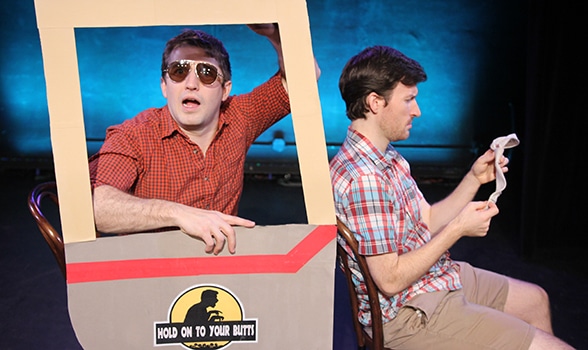
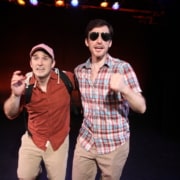
Human-powered indeed. While Jurassic Park features a central cast of more than a dozen, Hold On To Your Butts makes do with only two. Through changes in voice, body language, and eyewear, the actors leapfrog in and out of roles made famous by Sam Neill, Laura Dern, Jeff Goldblum, and others.
On top of this audacious doubling, developing Hold On To Your Butts also required judicious editing: while the movie clocks in at over two hours, the onstage parody cuts that runtime in half. As Parker puts it, “We try to include the parts that you would include if you were to describe the entire movie to your friend. You’re like, ‘Okay, so here’s this movie, and there’s this guy. . . .’ We’re hitting the highlights and the quirky things that jump out at you.”
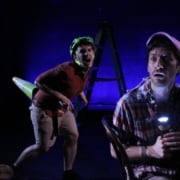
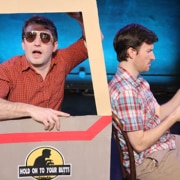
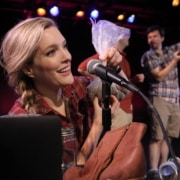
Photos by Jacob Hiss
Another area where Hold On To Your Butts differs from its source material is in its approach to special effects. With a budget of over $50 million, the team behind Jurassic Park brought dozens of dinos to life on the screen, including by building a life-sized animatronic T. rex. Compared to Universal Pictures, the team behind Hold On To Your Butts had somewhat shallower pockets.
“Our aesthetic is in the title,” says Parker, referring to Recent Cutbacks’ name. “We didn’t really have any money when we started making shows. So we just used stuff that we have around our house.” That includes an umbrella that the cast repurposes many times over, turning it into a helicopter one moment, a dinosaur the next.
This DIY approach is the beating heart of Butts. It also lends a low-tech spin to Jurassic Park’s critique of technological hubris. Parker says audience members have increasingly noted “how special it is to just watch something be made entirely by humans in front of you. I think there’s a certain anxiety about AI and digital media that [means that] the human-ness of art is really appealing to people right now.”
That human-ness is magnified by the show’s inclusion of an onstage Foley artist. Named after Jack Foley, a pioneering sound effects designer for 1920s radio dramas, Foley artists use physical objects and human vocalizations to give modern movies their sonic texture. In the case of Hold On To Your Butts, the use of Foley is both an artistic choice and a practical necessity.
“We’re not going to build a set or have a unique prop that exactly represents each item,” says Parker. While the actors are adept mimes who can conjure props from thin air, “we need something to land us in each world more fully and to punctuate that visual vocabulary.”
Hence the Foley artist, who can use silverware to produce metallic sound effects or rustle bits of trash to simulate footsteps on a leafy forest floor.
Like the physical frame that the show’s actors use to recreate dramatic close-ups, the use of live Foley is an intentionally transparent way of translating the techniques of cinema to the stage. “We’re not trying to hide the secrets or hide the strings,” says Parker. “We want you to understand that this is exactly how this was made.”
As Parker tells it, this opportunity for audience members to peek under the hood is a defining feature of live theatre and part of what distinguishes it from film. “There’s a more profound suspension of disbelief in the theatre,” she says. “You understand that you are not actually in the jungle. There’s a much more present, imaginative dialogue that’s happening between those of us onstage and those of us in the audience. We create the world together.”
The Denver Center for the Performing Arts (DCPA) NewsCenter is the organization’s editorial platform for stories, announcements, interviews, and coverage of theatre and cultural programming in Colorado. We are committed to producing accurate, trustworthy, clearly sourced journalism that reflects our mission and serves our community.