DCPA NEWS CENTER
Enjoy the best stories and perspectives from the theatre world today.


Have you ever had an ambitious dream that led you down an unexpected route?
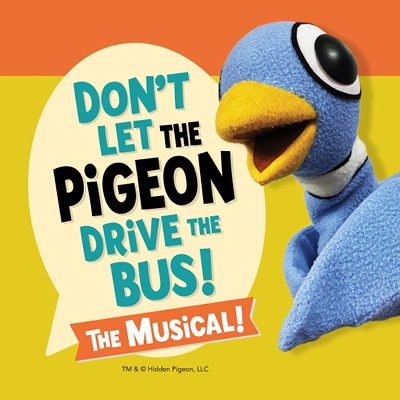
That’s the core of Don’t Let the Pigeon Drive the Bus! The Musical!, an interactive comedy adapted from Mo Willems’ beloved picture book that follows Pigeon, a tenacious, avian hero who is determined to get behind the wheel and take off.
“He’s a little guy, and he’s like, I want to drive the bus!” says director Allison Watrous about the loveable bird. “He has to navigate that it’s not quite his time – and what is his time is finding his thing, and the power of curiosity in the world.”
Over the course of the play, Pigeon runs into other dilemmas beyond convincing the bus driver and passengers that he’s capable of driving a public vehicle. He wants to have “a thing” of his own, whether that’s caring for a puppy or knowing his role in society. In short, Pigeon wants to find his place and make the world a better place – a desire that resonates with young people and the young at heart.
“There’s the power of ambition, and how amazing that is, and wanting to do things in the world. You have to find the thing that’s a fit for you and authentic for you. Sometimes there are things you have to grow into, and that’s okay too, because you have things on the horizon for you.” — Allison Watrous, Director
Originally published in 2003, the book Don’t Let the Pigeon Drive the Bus! won multiple awards, including the Caldecott Honor for both writing and illustrating. Many years and picture books later, Pigeon’s bus story (and other adventures) were adapted for the stage by Mo Willems and animation producer Tom Warburton during a residency at the Kennedy Center in Washington D.C.
Deborah Wicks La Puma’s lively jazz music accompanies the six-person cast, along with puppets, singing, and dance numbers. In 2019, the musical premiered at the Kennedy Center to enthusiastic audiences.
“It’s so incredible for young people to come to the theater, see themselves onstage, and see a story come to life so fully,” explains Watrous, who is also DCPA’s Executive Director of Education and Community Engagement. Together with her team, they have managed a wide range of educational programs over the years, many including adapting children’s literature for the stage.
“You meet a young person at the highest point of their intelligence, and they deserve incredible stories and humor. The way that Deb and Mo have put the show together, it has such musicality: the harmonies are rich, the singing is dynamic, it’s full — because young people deserve that. It’s full of laughter, and Mo really believes we deserve to laugh.” — Allison Watrous
Open any Mo Willems book, and you’re bound to laugh — and engage with the story right away. The books encourage a dialogue between the reader and the book character, and this often becomes a mini-performance in its own right. A parent, caregiver, teacher, or older sibling might read the book out loud for a young person, consequently transforming into an actor as they voice multiple characters. The pages become a stage; the illustrations, the set. And the person absorbing this reading performance leans in, responds to the characters’ questions, and offers opinions and judgment — all while laughing and pondering the dilemmas of Willems’ critters.
It’s a shared experience that becomes even richer when dramatically adapted, helping audience members become more imaginative and thoughtful as theatergoers, readers, critical thinkers, and lifelong learners.
“We have design conferences where we’re creating and planning scenically months in advance,” Watrous says, describing the process of bringing the play to life through not only the set, lights, props, and costuming, but also through the experience of walking through the lobby and entering the theater itself. “Dramaturgically, we bring in all the resources and look at the visuals of the source materials and the books. This is another powerful thing about creating for this age group: the play makes you a stronger reader. The stage visual connects to books on the page, the word-connection is happening out loud.”
It also integrates well with education and pedagogy. “We have incredible teachers who bring their students to see this book come to life, and then they start making connections between literature to theater and then to other art forms,” notes Watrous. “That’s connected to critical thinking, and that’s connected to learning across the board.”
RELATED: How does a pigeon drive the bus? Inside the design studio with Lisa Orzolek
Watrous has seen firsthand how connections with the theater and workshops have helped young people grow more creative and empathetic: “Theater gives you that immediate feedback of the actors onstage with you in that moment, and those shared experiences are so important when you see a young person stand up taller because they’re like, ‘I felt like the Pigeon in that moment,’ or they step into a workshop and say, ‘I get to be the voice of the Pigeon?!’ And for them it means that the artform is possible for me in my life.”
“That’s where art is incredibly powerful,” she adds, noting that these skills also make one a good citizen. “It cracks open what’s possible in your life.”
Even if you’ve had a big ambitious dream that didn’t quite pan out, maybe that dream was pointing to something else. Maybe it was pointing to another skill or talent you have, or another place in the world where only you can fit and grow.
When asked if she would let Pigeon drive the bus, Watrous laughed heartily. “I do think we gotta take things step by step,” she remarks. “Maybe it’s my teacher self, but we’re not there yet, so what can we find for you that’s your thing? Maybe when it’s your time, maybe you can drive the bus.”
“And time is a beautiful thing when you’re growing up!” she continues. “Take the time. I would never want to rush anyone in their growing up, and that’s why I’d say, Pigeon, don’t worry about driving the bus yet. Don’t worry about growing up so fast. You have all these magical years of growing up and being a young person.”
The Denver Center for the Performing Arts (DCPA) NewsCenter is the organization’s editorial platform for stories, announcements, interviews, and coverage of theatre and cultural programming in Colorado. We are committed to producing accurate, trustworthy, clearly sourced journalism that reflects our mission and serves our community.