DCPA NEWS CENTER
Enjoy the best stories and perspectives from the theatre world today.

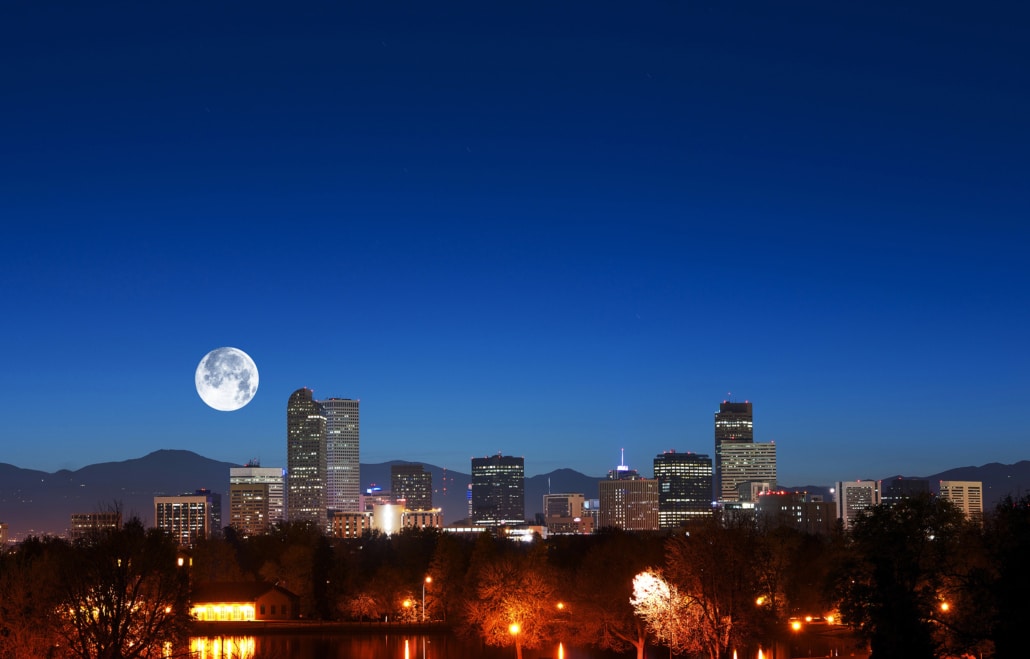
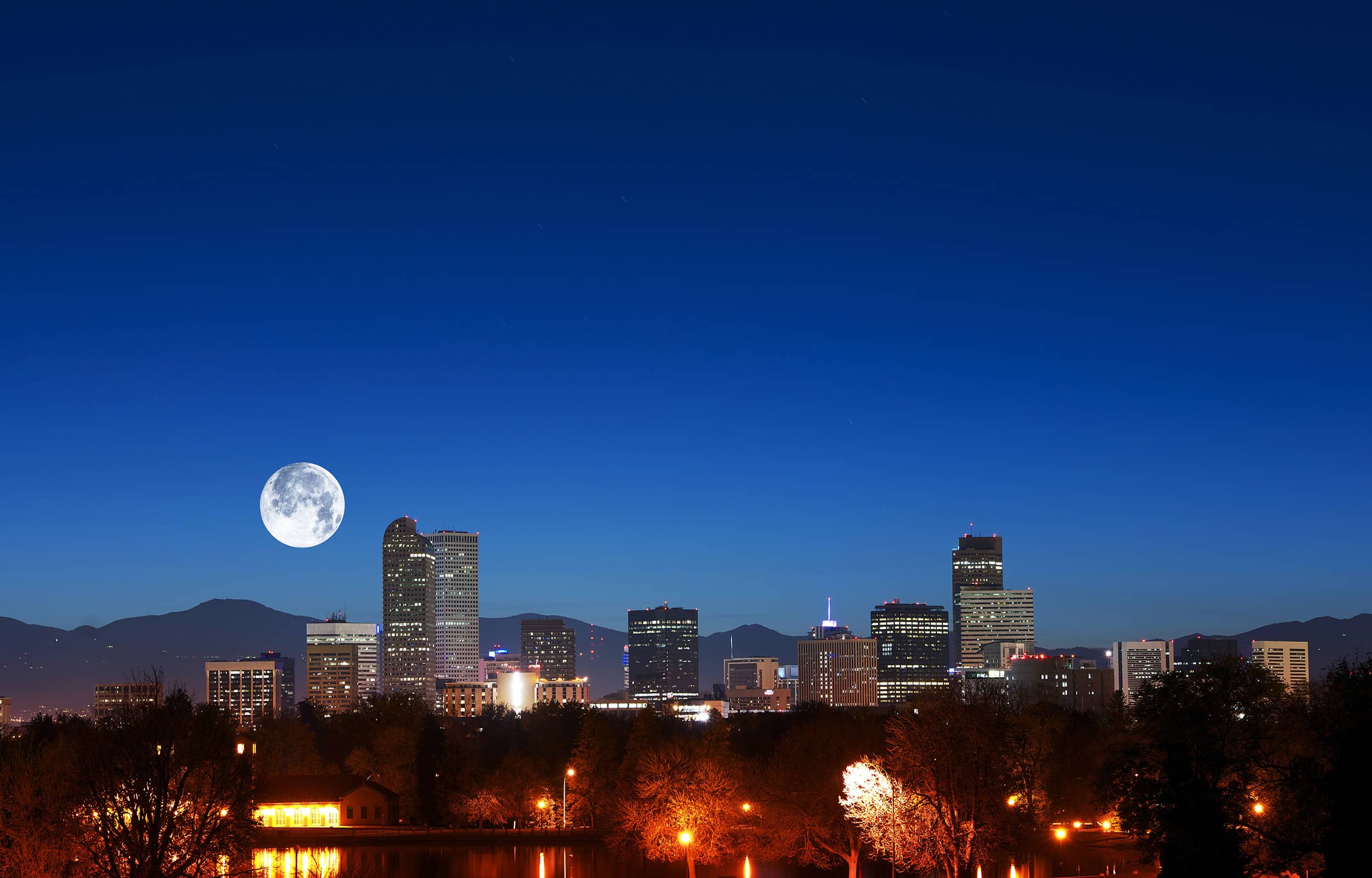
Denver Skyline, courtesy of Envato, American Cities Photo Collection.
Since the Helen G. Bonfils Theatre Complex opened in 1979, millions of patrons have stood on its balcony, or before the huge windows in the Seawell Ballroom, or under the glass-canopied pedestrian walkway called the Galleria or even on the roof of the adjacent parking garage and admired the simply spectacular view west, a sweeping panorama looking over lovely tree-lined Cherry Creek on to more than 100 named mountain peaks off in the distance. It’s impossible to look at this view and not be filled with awe and admiration for the city’s founders who chose such a beautiful location for a metropolis that would come to be called on August 1, 1876, when Colorado became the 38th state, the “Queen City of the Plains.”
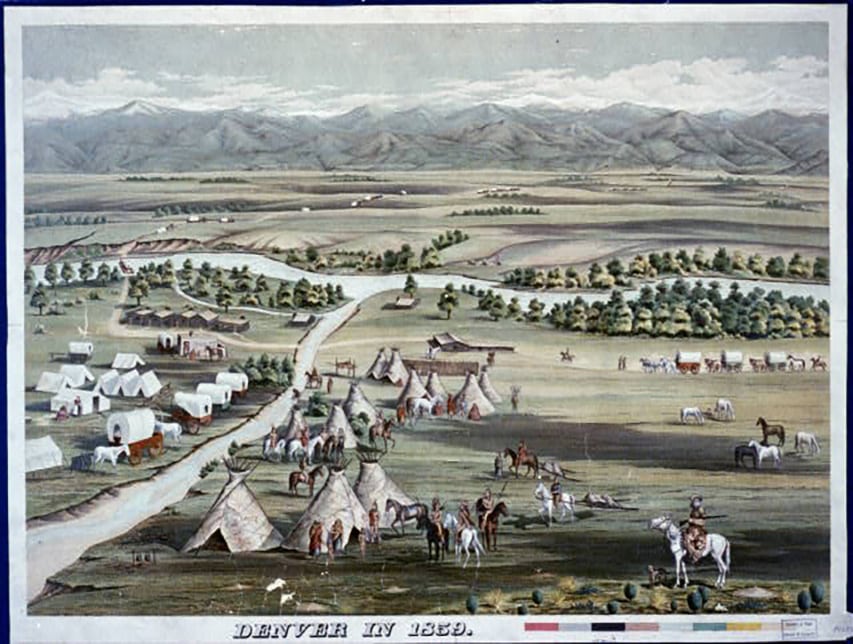
Denver in 1959. Retrieved from the Library of Congress
Of course, the part about the founders choosing a beautiful location? Nothing could be farther from the truth. Denver’s location is pure happenstance, due to a motley collection of mountain men, prospectors, gamblers, claim-jumpers, Confederates, and other near-do-wells mixed with liberal douses of a very potent “Taos Lightning” whiskey. It is one of the few major cities in history that was not on a port, navigable river, or road when it was settled. In fact, the only thing Denver’s location had going for it in 1858 as opposed to the hundreds of square miles of empty land surrounding it, was the shade provided by a stand of cottonwood trees at the confluence of a stream called Cherry Creek and the South Platte River. The only ones camping at this spot originally were a mountain man and his two wives. The mountain man, a despicable rascal from Scotland named William W. McGaa, had his name removed from anything in Denver least it burnish the town’s reputation, but his two Arapaho wives live on to anyone familiar with lower downtown. Their names were Wazee and Wewatta.
Here’s how it all went down.
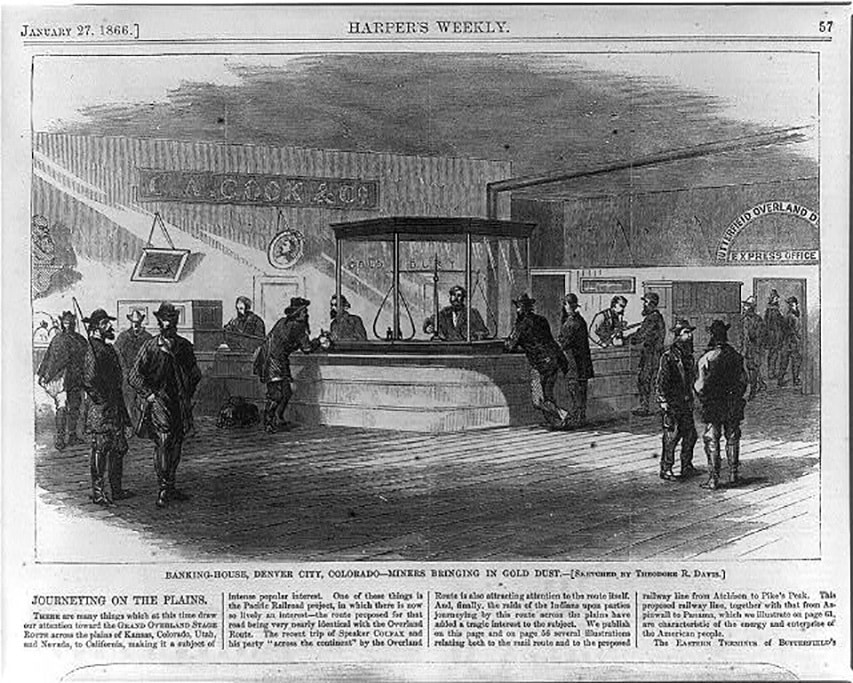
Banking house in Denver City, CO where miners brought gold dust. Retrieved from the Library of Congress.
During the great California Gold Rush of 1849, gold seekers crossing the country carried gold pans and tried panning every creek and river they passed on the roughly 2,000-mile trek from St. Louis. Not many came through the area that would become Colorado because of the Rocky Mountains to the west, instead traveling north through Wyoming. But in 1850, a fellow named Lewis Ralston dipped his gold pan into a stream that is today, Ralston Creek, Arvada and found a quarter of a troy ounce of gold worth almost $5 at the time (about a $1,000 today). Ralston went on to California, but eight years later he hooked up with a group of 100 Georgians led by William “Green” Russell and in the summer of 1858, they prospected up and down the same area and along the South Platte, finding traces of gold, but nothing spectacular. Most of the prospectors went home, but then Green Russell found 20 troy ounces of gold at Little Dry Creek, worth about $44,000 in today’s dollars. Remembering a pleasant stand of cottonwoods along Cherry Creek, they decided that would be a good place to encamp and, welcomed by McGaa and his Indian wives, they and others built a wretched “town” of log cabins with canvas cut from covered wagons for doors and roofs.
On October 3, 1858, they officially named their townsite Auraria, which was Latin for “gold.” A mountain man and Indian trader named Richens Lacy Wootton stumbled upon the camp with two wagon loads of goods he intended to trade for furs with the Arapaho. Instead, on an impulse, he opened two barrels of Taos Lightning whiskey, offered everyone a free shot, and by the end of the evening he was known as “Uncle Dick,” given great pieces of land and begged to stay on and open Auraria’s first business, which was, of course, a saloon.
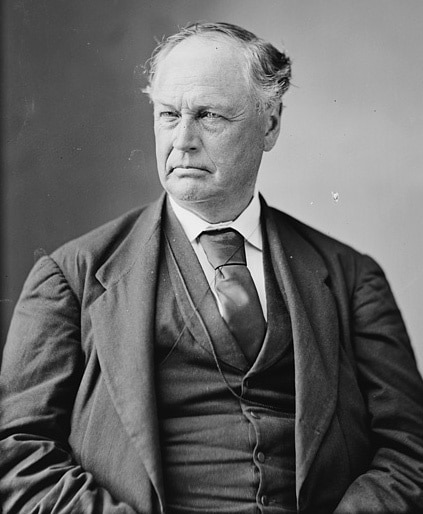
General James W. Denver. Retrieved from the Library of Congress.*
A month later, a group of businessmen from Kansas led by General (of Militia) William Larimer arrived at the same site, and seeing all the land south of Cherry Creek taken, they took the north bank. These men were not prospectors but land speculators; however, this land was already claimed as a townsite named St. Charles. Larimer simply offered the St. Charles people a choice. He held out a noose…and a small barrel of whiskey. They took the whiskey, and on November 22, 1858, Larimer established Denver City, named after his friend, Kansas territorial governor James Denver, unaware that Denver had just resigned. Nevertheless, Larimer created the Denver City Land Company to finance the creation of Denver City, issuing 41 shares to investors to develop 2,200 acres (about the size of 1,500 football fields).
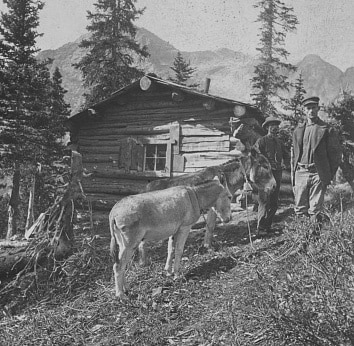
Keystone View Company Gold Miners in Colorado. Retrieved from the Library of Congress.
Unbeknown to both towns in 1858 was the fact that the word of a gold strike, however untrue, had spread to Kansas and one of the greatest migrations in American history was about to unfold. Within a year, some 100,000 men and women (mostly men at a ratio of 38 to 1) would cross the Great Plains in what was called the “Pikes Peak or Bust Gold Rush.” They came in wagons pulled by oxen, on horses, on foot pushing wheelbarrows, or just walking and carrying a pack. Most of them were completely unprepared for the 1,000-mile journey. Their animals died along the way, the gold rushers ran out of food, and they had encounters with Native Americans, buffalo herds and river crossings that tested their resolve. They finally arrived in Denver City to discover nothing but pure and utter chaos. Where they expected to pick up nuggets along the stream, there was no gold at all. When the mother lode was actually discovered nearby in Black Hawk and Central City, 30,000 men went there, lining the banks of every creek, most finding nothing.
If you can imagine the full stadiums of Invesco Field and Ball Arena emptying out at the same time with all those people having no place to stay, no food to eat, mostly young men, all carrying guns, no semblance of law, all of them bitterly disappointed, dirty, unshaved, dressed in rags and the only thing plentiful were cheap shots of whiskey for 25 cents, that will give you some idea of early Denver. Anything left unattended was stolen. Edward “Ned” Wynkoop, one of Larimer’s group, was appointed as first sheriff of Arapahoe County, Kansas Territory, which was then the entire NE quarter of Colorado, but a Miner’s Court of Vigilantes was the real law, and hangings were frequent. But not as frequent as killings, shootings, and robberies.
Most of the gold seekers quickly had enough and became “go backs.” Denver and Auraria were rivals from the start. Auraria had Uncle Dick’s saloon and since it was settled by Georgians, became a center for Southern sympathizers as the Civil War approached. Denver was strictly Union and had the backing of the first newspaper, the Rocky Mountain News. More important, it had unscrupulous leaders who offered 53 lots and nine shares to the Leavenworth and Pikes Peak Express, securing the first stagecoach connection for Denver, which was crucial because hotels and saloons wanted to be located near the stagecoach. Auraria finally conceded, and on April 5, 1860, it merged with Denver.
One of the first to arrive on the new stagecoach route was Horace “Go West Young Man” Greeley, the editor of New York Tribune who arrived in Denver on June 6, 1859, writing, “As to gold, Denver is just crazy. For the sake of the weary, dusty, footsore thousands I have passed on my rapid journey…I pray that gold may be found here in boundless extent, and reasonable abundance. For the very mothers who bore them would hardly recognize their sons now toiling across the Plains.”
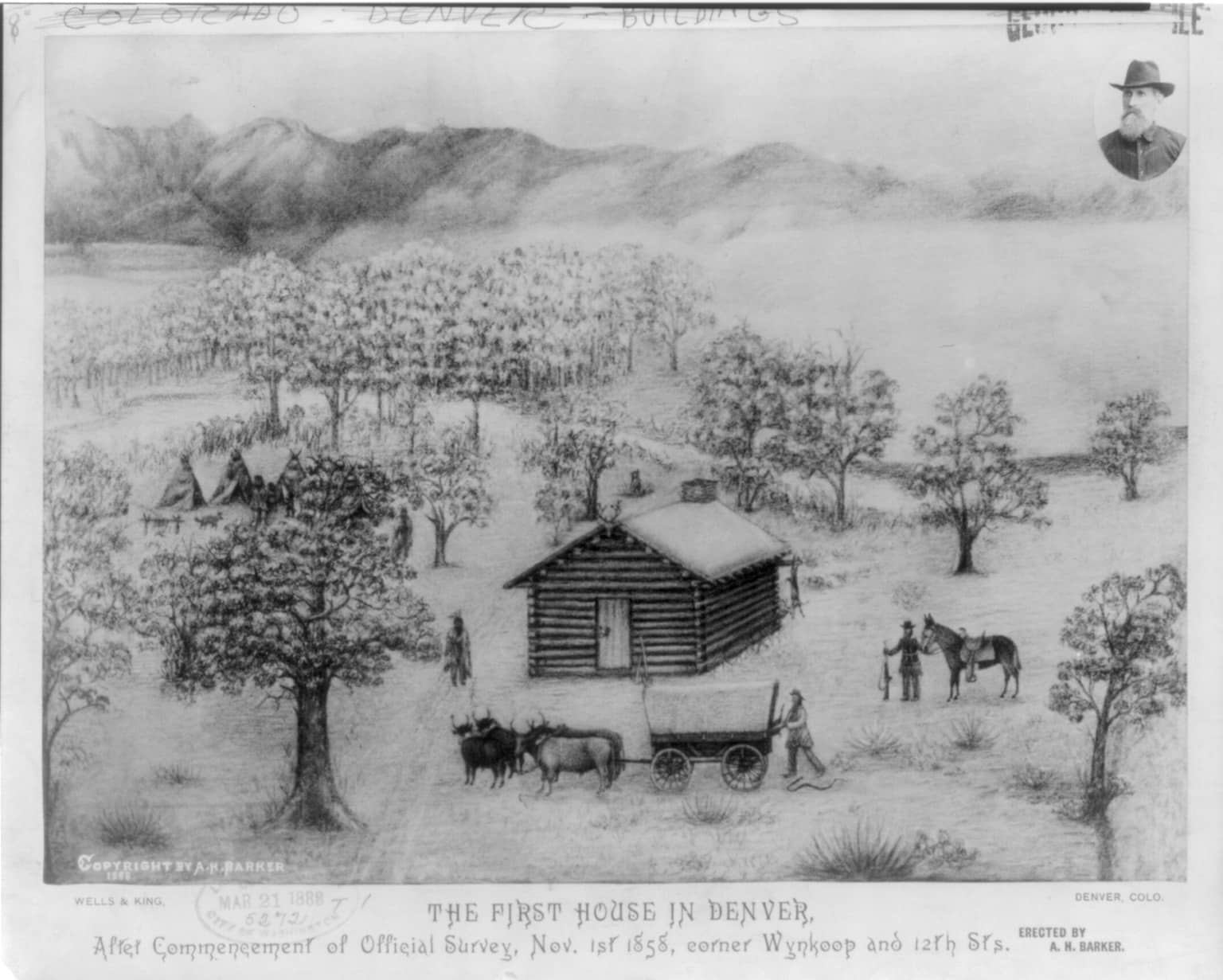
The first house in Denver at the corner of Wynkoop and 12th Sts, after commencement of official survey on Nov. 1, 1858. Erected by A.H. Barker. Retrieved from the Library of Congress.
He had less good things to say about Denver, describing it as a “log city of 150 dwellings, not three-fourths completed nor two-thirds inhabited, nor one-third fit to be,” with “every other house is a lager beer saloon or a brothel, sometimes both” and a town full of residents who were “prone to deep drinking, soured in temper, always armed, bristling at a word.”
At first, it seemed all fighting between Auraria and Denver was for nothing. Green Russell, Larimer and Uncle Dick all left. Denver’s population in 1860 was 4,749. By 1870, the city had added only ten people to 4,759, mostly because the gold was found elsewhere and because the first transcontinental railroad in 1869 had bypassed Colorado going through Cheyenne, Wyoming to the north. Denver was declared, “deader than dead.”
But the naysayers didn’t know Denver, and the beautiful awe-inspiring location it was in. Local business investors loved Denver so well, they raised cash and built their own railroad. By 1876 Colorado was a state, by 1880, Denver had 35,629 residents, and by 1890 the Mile High City population had soared to 166,713, larger than any city in Texas and second west of the Mississippi only to San Francico.
So maybe as we celebrate Colorado’s 150th birthday on August 1, 2026, the next time we take in that spectacular view from the Denver Center for the Performing Arts we really do have to thank those original founders for picking out Denver’s wonderful location, even if it was just by chance.
* The photo of General James W. Denver is cataloged by The Library of Congress as ‘Gen. John W. Denver (not in uniform),’ although the identification appears unverified. The subject is very likely James William Denver, the Kansas territorial governor and Civil War general for whom Denver, Colorado, was named.
The Denver Center for the Performing Arts (DCPA) NewsCenter is the organization’s editorial platform for stories, announcements, interviews, and coverage of theatre and cultural programming in Colorado. We are committed to producing accurate, trustworthy, clearly sourced journalism that reflects our mission and serves our community.