DCPA NEWS CENTER
Enjoy the best stories and perspectives from the theatre world today.

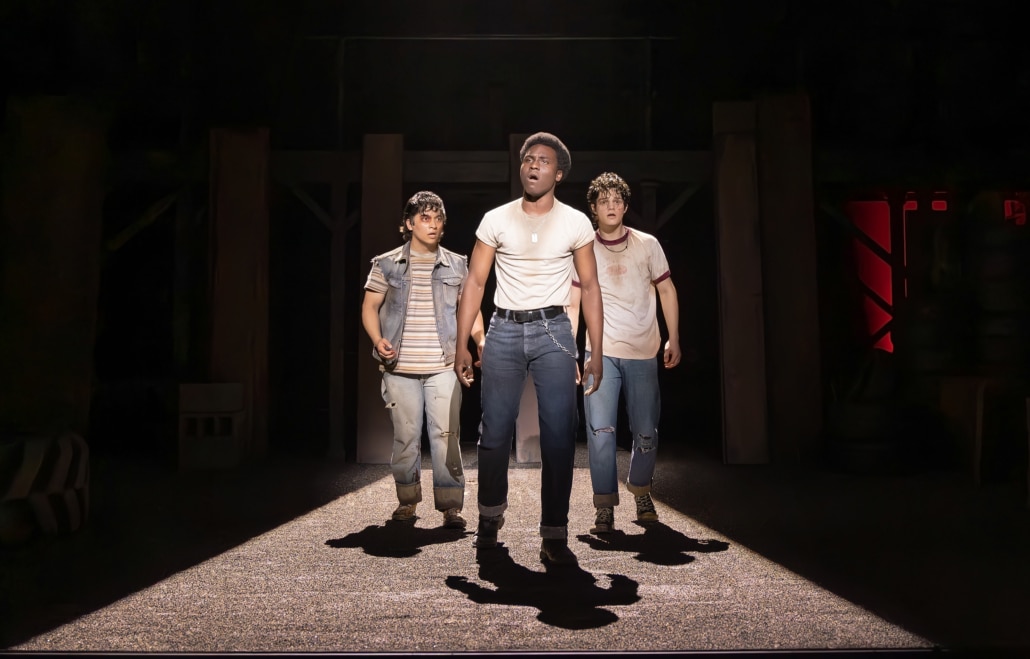

Sky Lakota-Lynch and Brody Grant. Photo: © 2024, Matthew Murphy
Long before Twilight, Divergent, and The Hunger Games, a teenage girl in Tulsa, Oklahoma invented the young adult genre. Susie Hinton was 16 when she wrote The Outsiders, which she sold to Viking Press under the name S.E. Hinton, so she wouldn’t be dismissed as just another girl.
“There was only a handful of books having teen-age protagonists: Mary Jane wants to go to the prom with the football hero and ends up with the boy next door and has a good time anyway,” Hinton told The New Yorker in 2014. “That didn’t ring true to my life. I was surrounded by teens, and I couldn’t see anything going on in those books that had anything to do with real life.”
At first, the book was marketed as an adult trade paperback – and it went absolutely nowhere. Then her publisher noticed that it sold in a particular demographic. “Teachers were using it in classes,” Hinton said. “All of a sudden, they realized that there was a separate market for young adults.”
Since its publication in 1967, The Outsiders has sold more than 15 million copies and continues to sell another half million each year. Those numbers don’t account for three generations of students who have read dog-eared classroom copies and library borrowings. Its fan base grew with Francis Ford Coppola’s 1983 movie rendition, and in 2024, the new musical based on the book won the Tony Award for Best Musical.
Hinton told the story of opposing gangs in 1960s Tulsa, which was profiting from an oil boom, leading to growing socioeconomic divides. Ponyboy, the narrator of the story, lives with his older brothers Darry and Sodapop, after the recent deaths of their parents. Their family of choice is the Greasers, lower income boys who stick together, get in trouble, and frequently come to blows with the Socs (short for socials), the rich kids. The only prominent girl in the story is Cherry, a Soc who breaks through by forming a friendship with Ponyboy.
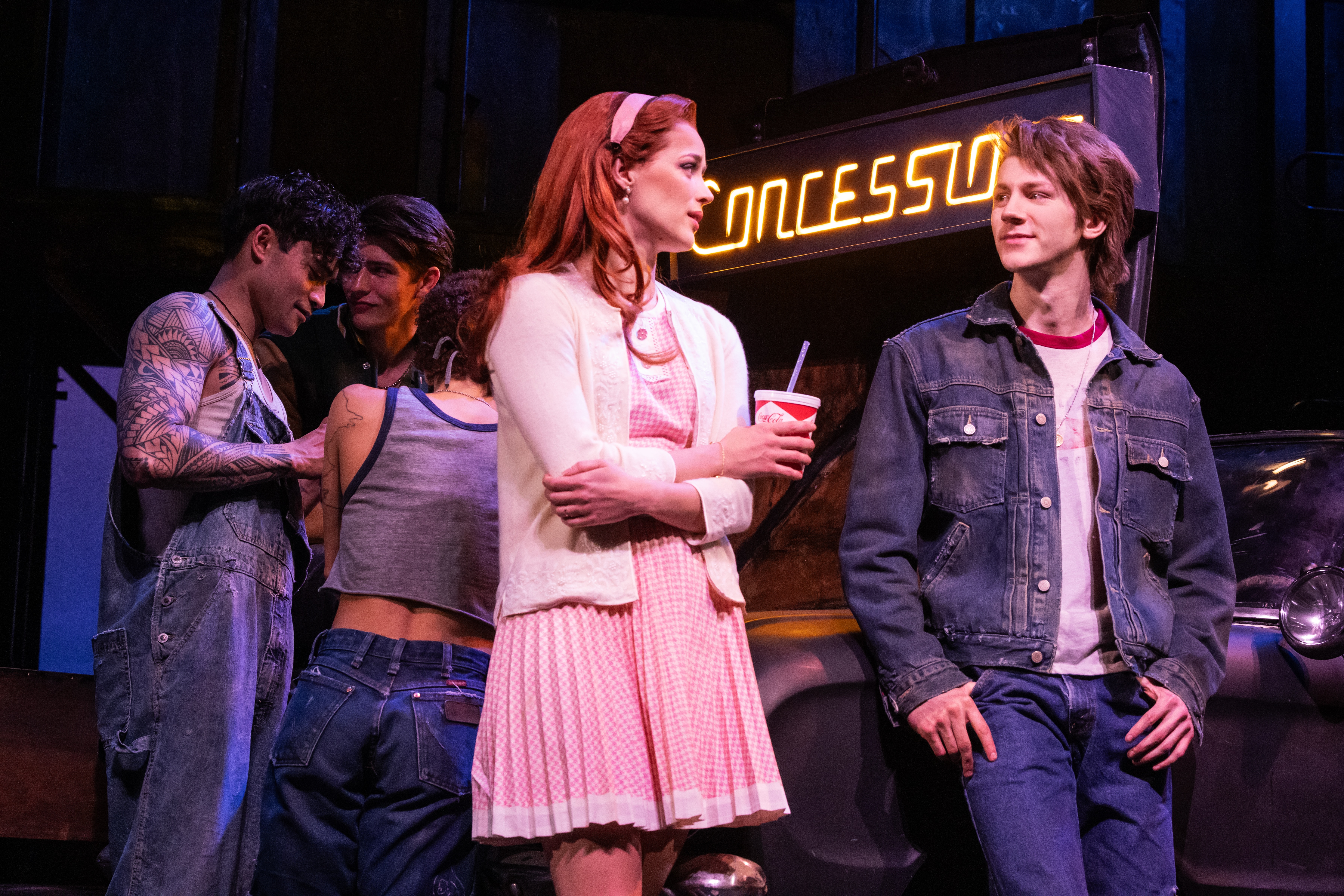
Emma Pittman and Brody Grant. Photo: © 2024, Matthew Murphy
Emma Hearn, who plays Cherry, has felt the impact of the novel through the passions of the audience.
“Truly, it spans all age ranges,” she says. “I’ve never been a part of a show that has such a wide reach as this story. Whether it’s people who read it in school decades ago, or they saw the movie in the ’80s. I know there are people who still read it in middle school to this day. We have such a loyal fan base. They love this story, and people want to see every iteration.”
Part of the immediacy of the stage musical comes from the youth of the performers, who aren’t far from their own teen years. Tyler Jordan Wesley was cast as Dallas (“Dally”) Winston – the most hardened of the Greasers – just a few weeks before graduating college at Texas State University. It is his first professional role.
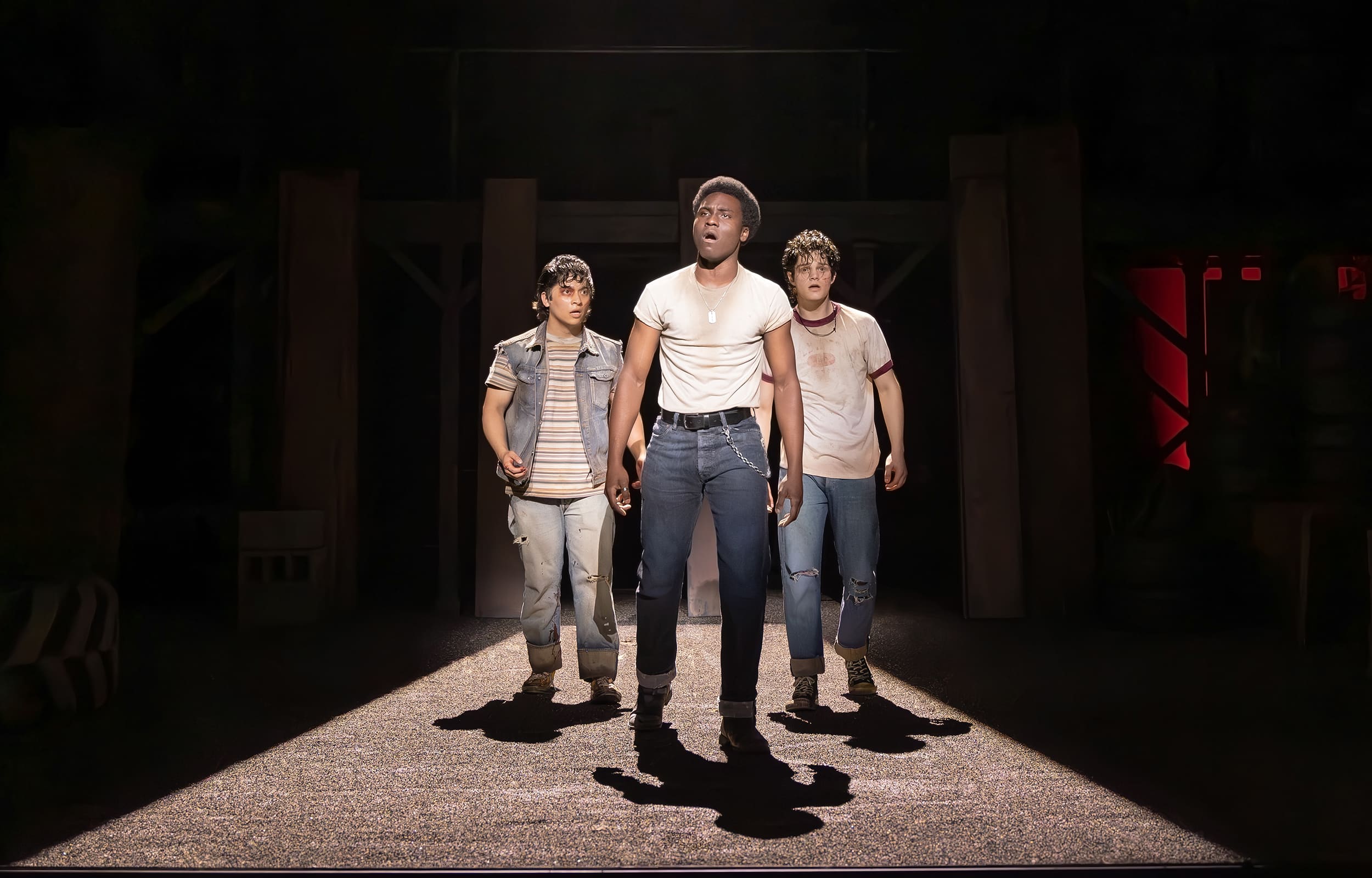
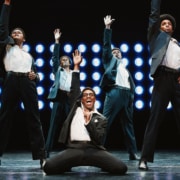
(l-r) Bonale Fambrini, Tyler Jordan Wesley, and Bolan White in The Outsiders North American tour. Photo by Matthew Murphy
“Our touring cast is notably younger than what the original cast was on Broadway, and so I think that the creative team did have an interest in looking toward people who might be in college,” Wesley says. “I think that for some people, it makes them even more immersed in the show and they can really understand their perspective when they know how young these boys are. Regardless of what age, what race, what gender is happening in this story, I just think that S.E. Hinton wrote a piece that is so integral to the human experience that it sits with you wherever you are. What S.E. Hinton was saying at the age of 16 is really what draws people to the show.”
In Hinton’s novel and the 1983 movie, all the characters are depicted as white. For the stage musical, however, the creators intentionally looked to a more diverse cast. It made sense, given the racial struggles of the 1960s, as well as Tulsa’s own history with racial violence. The Trail of Tears of the 19th century forced Native Americans on a decimating forced expulsion from the southeastern United States to Oklahoma. The character of Dallas is specifically written as a person of color; Wesley, who is Black, sees the connection between his own character’s traits and the Black history of Tulsa, where in 1921, whites destroyed one of the wealthiest Black neighborhoods in the nation.
Wesley sees all that history in the character he plays, who after three years on the streets of New York came to Tulsa angry, violent, and fiercely loyal. “In the 1960s, this is the height of the civil rights movement, Dallas is from New York, so what things have I seen, what atrocities have I witnessed at the age of 19 to get me to where I am now?” Wesley says. “As malicious as I think people take Dally to be throughout the book, at the heart of this story we’re all human. We start out gold and it fades away throughout life. I get to share with America and Canada how I believe Dally’s gold is tarnished throughout life.”
Including people of color in a classic American story stays true to Hinton’s depiction of divisions and connections, of innocence found and lost. “At its core, it’s saying, ‘Stay gold,’” Wesley says, echoing the classic line from the book. “It doesn’t say, ‘Stay gold, white American’ or ‘Stay gold, Black American. It says, ‘Stay gold.’”
READ MORE
The Denver Center for the Performing Arts (DCPA) NewsCenter is the organization’s editorial platform for stories, announcements, interviews, and coverage of theatre and cultural programming in Colorado. We are committed to producing accurate, trustworthy, clearly sourced journalism that reflects our mission and serves our community.