DCPA NEWS CENTER
Enjoy the best stories and perspectives from the theatre world today.

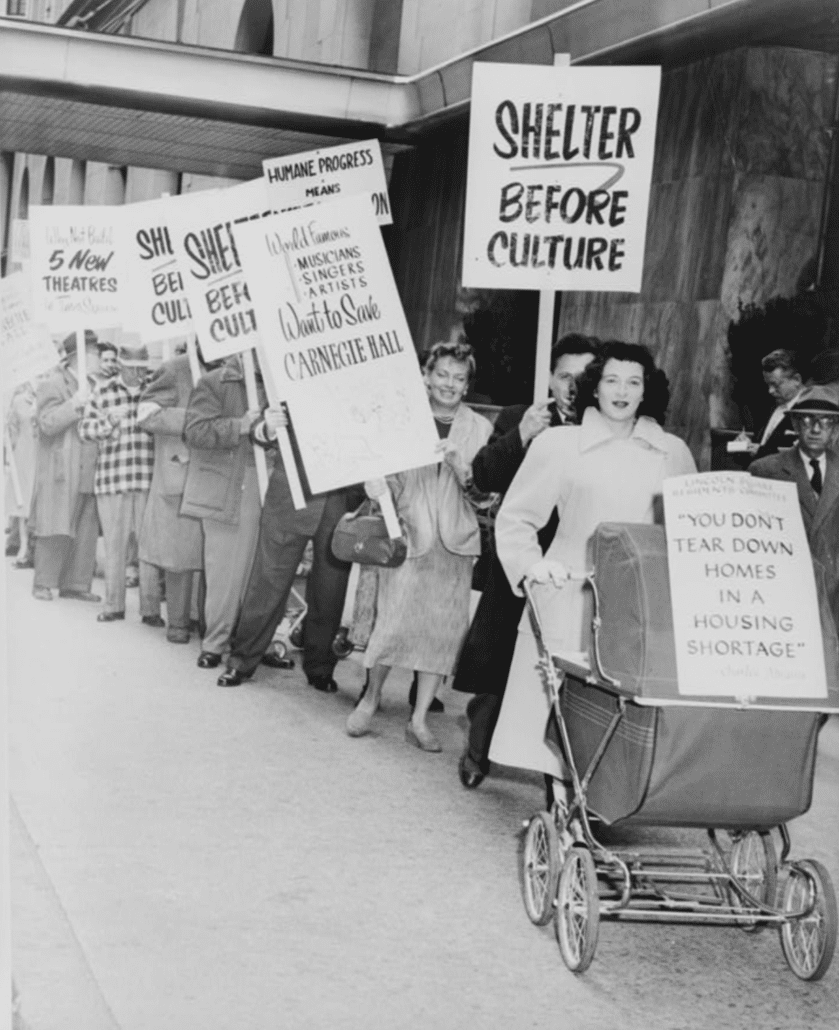
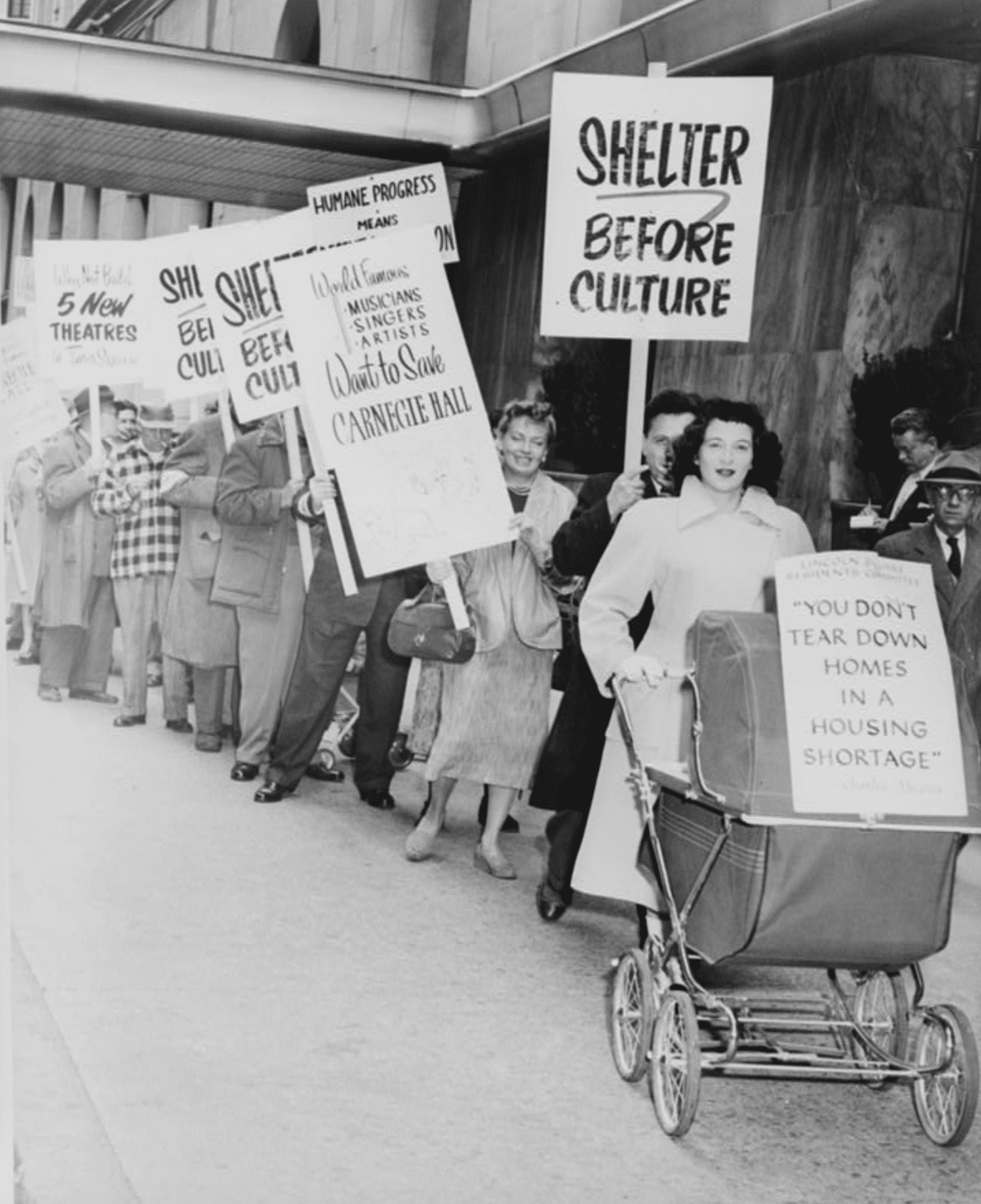
Mrs. Ellan Levitt leads a pickett line of individuals protesting destruction of Lincoln Square to make way for Lincoln Center. Photo by Phil Stanziola for New York World Telegram & Sun. Photo courtesy of Library of Congress, Prints and Photographs Division, NYWT&S Collection, #LC-USZ62-121121.
Playwright Matthew López characterizes his play Somewhere as a “story about a family with dreams and a world that [is] indifferent to them.” Guided by the strength and spirit of a fierce, passionate mother, and brimming with undeniable talent, a tireless work ethic, and endless dedication, the members of this black, Puerto Rican family fight for a place in the artistic universes of both stage and screen while facing forced eviction from their neighborhood to make way for the Lincoln Center in 1950s New York.
This “play with music and dance” delves deeply into the transformation of place, the erosion of a neighborhood, and the erasure of community. If you are looking for a simplistic characterization of gentrification as a societal ill, you will be disappointed. López presents the issue in all its complexity. In an interview with American Theatre magazine, he maintains:
“I never purposefully set out to write a play about gentrification. … [New York City Urban Planner] Robert Moses would have told you that progress requires sacrifice and the good of the many outweighs the rights of the few.… No one could say that the presence of Lincoln Center has not been an absolute good for the city and, by extension, the nation.… Somewhere makes no judgment as to the value of the enterprise; it simply asks that the audience consider who was there before and what happened to them after. That is the story of New York and, again by extension, the country. It is the same question that must be asked when we send young men and women off to war. When we decide that healthcare is too expensive a burden for us to cover as a nation. And, as we have recently and tragically learned, when we decided that the rights of gun owners are more important than the safety of children. The question must always be asked: at what cost?” — Matthew Lopez, playwright
At its simplest definition, gentrification is the effort to upgrade or rehab an older or less affluent area; while it often results in new job opportunities, increases in property values, and reduction in crime among other benefits, it too often devastates lower income neighborhoods, decreases space for small businesses, reduces the availability of affordable housing, disrupts communal history and culture, and leads to re-segregation. Its negative consequences overwhelmingly impact lower-income residents and communities of color.
Gentrification is by no means strictly an East Coast phenomenon. In 1974, under the guise of urban renewal, residents in Denver were subject to forced relocation from their communities, neighborhoods they had come to live in due to redlining, in order to make room for the Auraria campus near downtown. In many ways, the impact on the original inhabitants — who were largely Hispanic — was devastating. One segment of the population, however, was uniquely positioned to serve as place-keepers – the artists. Their role in gentrification is complicated by their very existence because their work often attracts the upper-classes to the area, which ultimately leads to their displacement.
What occurred with Auraria in Denver is not dissimilar to what happened in Soho in New York. In a process described as “textbook,” Soho, “originally a manufacturing district, became a hub for artists in the 1960s and 70s. However, the cultural capital generated by artists eventually attracted galleries, boutiques, and high-income residents, transforming Soho into one of Manhattan’s most expensive neighborhoods.”
In both instances, the role of community members in decision making was limited and many of their concerns were not considered. As Billie Bramhall, a retired city planner for the City of Denver noted, “This is not to say that it was a mistake to clean up and redevelop portions of downtown, which included the build of the Auraria Higher Education Center. However, it is to say that it was overdone with a sword not a scalpel.”
There was minimal space for the voices and contributions for artists in the process as well. Manuel Aragon, a Latinx director and filmmaker in Denver, notes that despite their expressed interest in the culture that was already in evidence, those involved in development of these spaces paid little heed to their impact on the existing culture. Aragon suggests that potential new residents “want that cultural currency of the area but the comforts of the suburbs; they want it to be “safely adjacent;” so even as they move in, they transform it into something else.
In addition to financial implications, the transformative process imposes major emotional and psychological stresses on the inhabitants as well, effects that are rarely explored in advance. DL Cordero, a Denver-based nonbinary, queer, Afro-Latinx, and Taíno author who focuses on creating stories featuring marginalized communities asserts that loss of place “induces a sense of psychological homelessness…. It is like, ‘where am I from if where I am from no longer exists?’ You’ve lost a piece of yourself.” Cordero also suggest that artists and the arts are uniquely qualified to assist in dealing with those stressors:
“Dealing with gentrification as an artist is a way to move through grief.” For them, art itself can help heal. “…I try and transform [the loss] into something different through the artistic process as a way to honor the grieving process. It’s sort of like I’ve created my own place to exist through creating art.”
Gentrification is not inherently good or bad. Artists are uniquely qualified to serve as holders of culture and of place, as promoters of connection, as arbiters of healing. They not only possess the ability to mitigate the harm, but some would say the responsibility. And in many ways, in Somewhere, Matthew López does just that.
The Denver Center for the Performing Arts (DCPA) NewsCenter is the organization’s editorial platform for stories, announcements, interviews, and coverage of theatre and cultural programming in Colorado. We are committed to producing accurate, trustworthy, clearly sourced journalism that reflects our mission and serves our community.