DCPA NEWS CENTER
Enjoy the best stories and perspectives from the theatre world today.

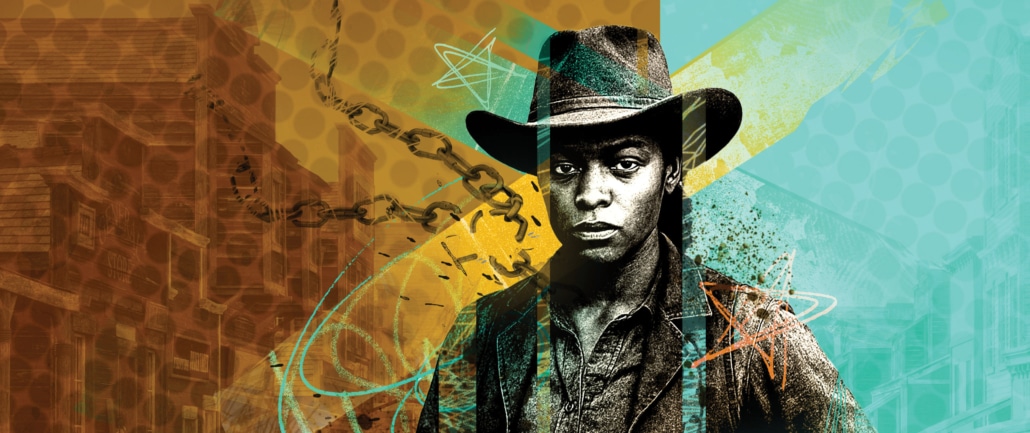

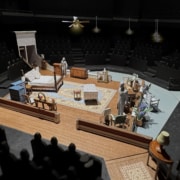
To create the 1865 Texas of Terence Anthony’s Godspeed, the design team had several challenges to confront. The first was how to create the journey at the heart of the play when the theatre was in the round.
“It was actually quite a big challenge in terms of the conceptual shift that everybody had to make, since the play was inspired by Westerns,” says Scenic Designer Tanya Orellana. “The easiest solution is to have it in a proscenium and wagons coming in and out. I think when it was first conceived of by the writer, it was a little bit like he was watching a movie in his head, but we’re asked to put it in the round.”
To solve the problem, Orellana designed a “donut” turntable, in which two concentric turntables revolve in opposing directions. This created a sense of movement. “I think in the end, putting it in the round allowed us to really see the journey,” Orellana says.
That staging also allows audiences to connect more deeply with the story. “It really inspired us to want it to feel immersive when the audience walks in,” Orellana adds. “Having the audience be able to walk into the landscape is actually very significant to having them feel more present within the landscape of the show and the history that the show discusses.”
Director Delicia Turner Sonnenberg assembled a predominantly female design team (with the exception of lighting designer Charles R. McLeod) in the telling of a story about a woman who transcends the gender expectations of her time (Denver Center audiences may remember Orellana’s design for 2024’s Where Did We Sit on the Bus?). “This is my second time working with Delicia and one of the amazing things about her, I think when you get feedback from her, is she sees what you’re trying to do. She’s a very designer-friendly director, and that leaning into your collaborators is something I associate more with female-identifying directors.”
Much like the world of the play, the design itself has many stylistic influences, while maintaining the specificity of its Texas setting.
“We wanted it to live somewhere between realism and an installation of post-Civil War. There was a part of us that was very much influenced by Westerns also. There’s the idea people have of the Civil War in the South, but this is not the Civil War in the South. This is Civil War in Texas.” — Tanya Orellana, Scenic Designer
The space they were creating would be like an installation, a three-dimensional piece of art with people (characters) moving through it. How would they reflect a nation that had been torn apart?
“There’s a bit of a post-apocalyptic feel,” Orellana says, reflected in broken furniture, broken cinderblocks, scattered pieces of functional lighting. “You’re seeing those details in the landscape, but they’ve been covered slightly by the mud of the world. There’s a sense of the world that has just ended, but it’s starting to become one with the landscape.”
Later, a world of plants enters the set. The plants suggest the geographic location of the characters, but it goes farther, Orellana says. “We’re also showing that after the destruction there’s this growth and this moment of rebuilding in the country.”
DETAILS
Godspeed
Jan 30-Feb 22, 2026 Kilstrom Theatre
Tickets


 ©Denver Center for the Performing Arts