DCPA NEWS CENTER
Enjoy the best stories and perspectives from the theatre world today.



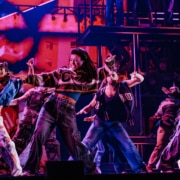
Maya Drake and the company of the North American tour of Alicia Keys’ Hell’s Kitchen. Photo by Marc J Franklin
A city. A neighborhood. A building. These are the geographies that feed 17-year-old Ali, our guide in Alicia Keys’ Hell’s Kitchen, book by Kristoffer Diaz. Hell’s Kitchen is the piquant —and for decades, the rightly earned — name of the West Side Manhattan neighborhood where Ali lives with her mother, Jersey. Their home is in a towering apartment called Manhattan Plaza, a vertical abode Ali introduces in the show’s opener, “The Elevator Prologue.”
“All art has to have an address,” Oskar Eustis offers in Hell’s Kitchen: Making the Dream, a ridiculously instructive and enjoyable making-of book. Eustis, the artistic director of the Public Theater, attributes that quote to the late novelist Bernard Malamud, a Brooklynite. And it was the Public that produced Hell’s Kitchen before it headed to Broadway and 13 Tony nominations.
Given that notion of place, it’s easy to wonder which fanciful yarns about place spin our identities? (How many times have you, dear local, embraced Denver’s “Cowtown” brand?) And which concrete and rebar realities define us? (How many times has a new build downtown rebuffed that same moniker?)
Some beloved musicals evoke a place then deliver something slightly different. Oklahoma! Chicago. West Side Story. Although that last one shares some discernable DNA with Hell’s Kitchen, as does Lin-Manuel Miranda’s Washington Heights love letter, In the Heights. But there’s a special intimacy to Keys’ dynamic musical about a young woman edging toward a deeper understanding of herself.
Like onstage-Ali, Keys grew up in Manhattan Plaza with her single mother, Teresa, and a building filled with artists, theater-makers, musicians. (Famed tenants of that 46-story bastion adjacent to the Theater District include Jane Alexander, Giancarlo Esposito, Angela Lansbury, Dexter Gordon, Mary Jo Slater and her boys, Christian and Ryan; the list is long). Due to Federal funding rules, 70 percent of the apartments are earmarked for people making their spare, passionate living in the arts.
Those involved with this hit Broadway musical, however, caution treating it as an autobiography or even that often beloved, and increasingly derided genre, the “jukebox musical.” For a good reason. Hell’s Kitchen is not the story of Keys’ big breaks: of her bold decision to leave Columbia Records for hitmaker Clive Davis and Arista, or Davis’ call to Oprah Winfrey, asking the talk-show diva to consider putting the young, piano-playing phenom on her show. She did and the girl from Manhattan Plaza took flight becoming over time one of the best-selling female artists of all time. No, it’s not that story. But if you want the full saga, brimming with lessons in seeking and finding, Keys’ 2020 memoir More Myself: A Journey is a terrific read — and even better with Keys reading it.
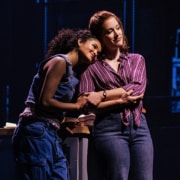


Instead of a career retrospective, Keys, Diaz, and director Michael Greif (Rent, Next to Normal) foreground a daughter-mother love story against the backdrop of the goings-on at Manhattan Plaza. That Ali and Jersey’s affection is vexed, tenacious, and snappish is par for the course. (Mothers of teenage daughters, can I get a witness? Daughters of cool but protective mothers, a “hell yeah”?) Although absent for too much of his daughter’s life, Ali’s father, Davis, figures into the musical crucially.
In eschewing an autobiography, the creative team also dodged making a show that goes from hit to hit to hit. Keys’ discography presented exciting challenges, recalls librettist Diaz. “There were five or six songs that had to be in the show, right?” he said on a video call in early January. “Where’s ‘Fallin’’ going to be? Where’s ‘No One’ going to be? Where’s ‘Girl on Fire,’ going to be?” Some of them were easy to figure out. “Empire State of Mind,” that hit Keys made with the rapper Jay-Z and then remade as a solo effort, “can only be the opening number of the show or the end number of the show,” he jokes knowing this doesn’t require a spoiler alert.
RELATED: Desmond Sean Ellington: Finding the Humanity in a Villain in Hell’s Kitchen
Although Diaz grew up in Yonkers, a city north of the Bronx, he and Keys shared a cultural moment. Hip hop defined their youth and gave New York City its swagger. When Keys wanted to sing the praises of bucket drummers, he knew exactly who she meant. And during their first meeting, when he wondered aloud, gesticulating as he went on about a possible nontraditional structure for the musical, “for some reason the image of Nas’ ‘One Mic’ came to mind, which starts out a quiet verse that crescendos and then gets simple and quiet, crescendos and gets quiet again. We could do something like that.” She got it. Though in the end, they went for something mildly less ambitious.
Time period is a place, too, it turns out. And the Manhattan of the 1990s in which the show is set was suffused with the spirit of Hip Hop. The genre was already a couple of generations in when Keys and Diaz were coming of age. But the thing about Hip Hop, especially during that era, was how utterly aware of its antecedents it could be: praising and quoting, sampling forebearers and doing them one better. And it wasn’t just music, it was style, street fashion, tagging, and graffiti. Keys relishes that place and its moment — and all of it gets its due in that city, that neighborhood, that building, this musical.
The Denver Center for the Performing Arts (DCPA) NewsCenter is the organization’s editorial platform for stories, announcements, interviews, and coverage of theatre and cultural programming in Colorado. We are committed to producing accurate, trustworthy, clearly sourced journalism that reflects our mission and serves our community.