DCPA NEWS CENTER
Enjoy the best stories and perspectives from the theatre world today.



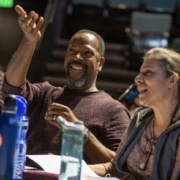
Sadithi De Zilva and Minita Gandhi. Photo by Jamie Kraus Photography
When her play, Cowboys and East Indians, has its world premiere, playwright Nina McConigley thinks it’s going to be mind-blowing for her mother, who was born in India and lives in Wyoming, to see actors wearing saris onstage at the Denver Center for the Performing Arts.
Growing up in Casper, as “the other kind of Indian in Wyoming,” McConigley said, there wasn’t another sari in sight. Nor an Indian grocery store or restaurant. Her Indian/Irish-American family moved to Wyoming when she was a baby. Her mother found it difficult to adjust to the emptiness and new culture, while Nina grew up feeling confused and isolated.
“T
he play isn’t so much about race; it’s about not seeing a version of yourself and what that does. Wyoming is one of the least racially diverse states, and it is a different kind of growing up.”
— Nina McConigley, Author of Cowboys and East Indians
She hopes the play, co-adapted by Matthew Spangler from her semi-biographical short story collection of the same name, reinterprets the American West for audiences. “I hope it gives people a different look at Wyoming and the idea of rural immigration.”
Like her main character, “I did live back home with my family when my mom had cancer. When I wrote the short story, it was about anxiety for me. So much of my sense of Indian-ness was through my mom and I did think, if I lose her, I don’t know what’s going to happen.”
Now a professor at Colorado State University, her new novel, How to Commit A Postcolonial Murder, will be published simultaneously with the world premiere of Cowboys and East Indians, which was a hit at the Denver Center Theatre Company’s 2024 Colorado New Play Summit, delivering a smart mix of culture-clash comedy and pathos that sparked tears and laughter in a staged reading.
McConigley and Spangler met in their hometown of Casper and followed each other through middle and high school, each harboring a love of the West, the sparse landscape and the people. DCPA Director of Literary Programs Leean Kim Torske, the show’s dramaturg, is also from Wyoming and co-commissioned McConigley and Spangler to adapt the short stories for the Denver Center Theatre Company.
Best known for his stage adaptation of The Kite Runner, Spangler is a playwright and professor of performance studies at San José State University where he teaches courses in how refugees and asylum-seekers are represented through the performing arts. One of his other plays, The Beekeeper of Aleppo, co-written with Nesrin Alrefaai and based on the bestselling novel by Christy Lefteri, will receive its second UK tour this spring.
When she wrote Cowboys and East Indians, McConigley said, she never thought of the story as a play.
Spangler recalled the pair participated in a 2022 panel discussion in Casper and hypothetically talked about how they might approach adapting Nina’s collection of short stories for the stage. Eventually, this hypothetical discussion would lead to a real commission and collaboration.
Although popular culture is full of Irish, Italian, Chinese, Jewish, and other New York City immigration stories, McConigley notes a lack of stories about rural immigrants. “While it is difficult being an immigrant anywhere,” she said, “unlike cities with diverse ethnic populations, Casper is very monocultural. I just wanted to write about my experience of growing up, brown in Wyoming, really.”
When there is no reflection of yourself in the world around you, your identity is in question. “There was a brief moment as a kid when I [described myself as] ‘Arapaho,’” McConigley said. “Easier than explaining…”
For Spangler, who has generations of Wyoming family history, “the play essentially is about loneliness, how we deal with loneliness, and how we try to create senses of belonging to mitigate loneliness. Sometimes those spaces of belonging are risky.”
“There’s something about [the Wyoming] landscape that’s beautiful, striking, and also its own metaphor for loneliness.”
— Matthew Spangler, Co-Adaptor of Cowboys and East Indians
McConigley recalls visiting numerous book clubs around Wyoming when Cowboys and East Indians came out, “and having many people say to me, ‘I’ve never thought about race in Wyoming.’ And I just thought, ‘What a privilege, you never had to. You just aren’t in the minority.’”
For his part, Spangler said, “to be able to write a play set in our hometown and work with people I’ve known for decades is something I never thought I’d be able to do.”
Cowboys and East Indians is ultimately a hopeful play that’s packed with wide-ranging emotions and that subverts expectations in multiple ways. “I was surprised people cried during the New Play Summit,” McConigley said. “The play is hopeful. It asks you to look at those around you, and you don’t know the story within them. You just don’t know. I think the play surprises a lot of people. Watching the audience was so interesting, you can visibly see the audience stressed, then relieved, then a little bit confused….”
Both express gratitude to the Colorado New Play Summit and Denver Center Theatre Company. “We learned so much from that workshop,” McConigley said. “The fact that they financially supported us to write this play….” As a mother of young children and a full-time professor, she said, there’s no way she could have done it otherwise.
“I’m definitely wearing a sari on opening night. My mom, too.”
DETAILS
Cowboys and East Indians
Jan 16-Mar 1, 2026 • Singleton Theatre
Tickets




 ©Denver Center for the Performing Arts