DCPA NEWS CENTER
Enjoy the best stories and perspectives from the theatre world today.



Blake Segal and Major Attaway in the North American tour of Spamalot. Photo by Matthew Murphy and Evan Zimmerman
Let’s start by getting the vocabulary straight. The word pythonesque means long, scaly, and capable of devouring a Bornean bearded pig in a single bite. By contrast, the word Pythonesque (capital P this time) means absurd, sharp-witted, and otherwise reminiscent of the British comedy troupe Monty Python, none of whose members are snakes.
In addition to spawning their own adjective, Monty Python has achieved such universal recognition that their influence on comedy has been compared to The Beatles’ influence on music. More than 50 years since the release of Monty Python and the Holy Grail, iconic scenes featuring the French Taunter and the Black Knight remain as quotable as ever — even for those who have yet to see the movie. Indeed, that was the experience of Josh Rhodes, who received his first introduction to Python in college.
“You can’t go to theater school without everyone quoting Monty Python,” Rhodes said during an interview that fittingly took place on April Fools’ Day. “Before I’d ever seen it, I knew all the quotes. But finally somebody got out a VHS tape and said, ‘Look what I got!’”
In the years since that initial screening, Monty Python has come to play an increasingly prominent role in Rhodes’ life and career. In 2005, when Python veteran Eric Idle adapted Monty Python and the Holy Grail into the Broadway musical Spamalot, Rhodes’ husband joined the cast in roles that included Sir Bedevere and King Arthur’s squire Patsy. And though he kept his 2005 Spamalot ticket stub, Rhodes never guessed he would one day direct and choreograph the show’s 2023 revival and subsequent national tour. “It’s been a wonderful progression,” he said, “from VHS tape to actually getting to do it eight shows a week.”
As someone who grew up in the Midwest, where “British humor was not something that was easily accessible,” Rhodes has a keen appreciation for how Spamalot caters to Python superfans and newcomers alike. For those who can quote the movie by heart, the musical affords ample opportunity for vocal participation. When the much-beloved Knights Who Say “Ni!” appear onstage, expectant audiences will often shout “Ni!” along with them. “It’s just electric,” Rhodes said. “There are certain moments where the audience acts as a Greek chorus.”
And for theatergoers who have never contemplated the airspeed velocity of an unladen swallow, Rhodes was pleased to report that “the material stands as is. It’s still absolutely delightful, and it’s absolutely absurd, and it’s joyful to meet these characters for the first time.” That includes the Black Knight, whose blindly optimistic brand of mortal combat requires no prior introduction. “‘It’s just a flesh wound’ and all those things are hilarious,” said Rhodes, “even if you didn’t grow up saying it to your friends while you’re fighting on the playground.”
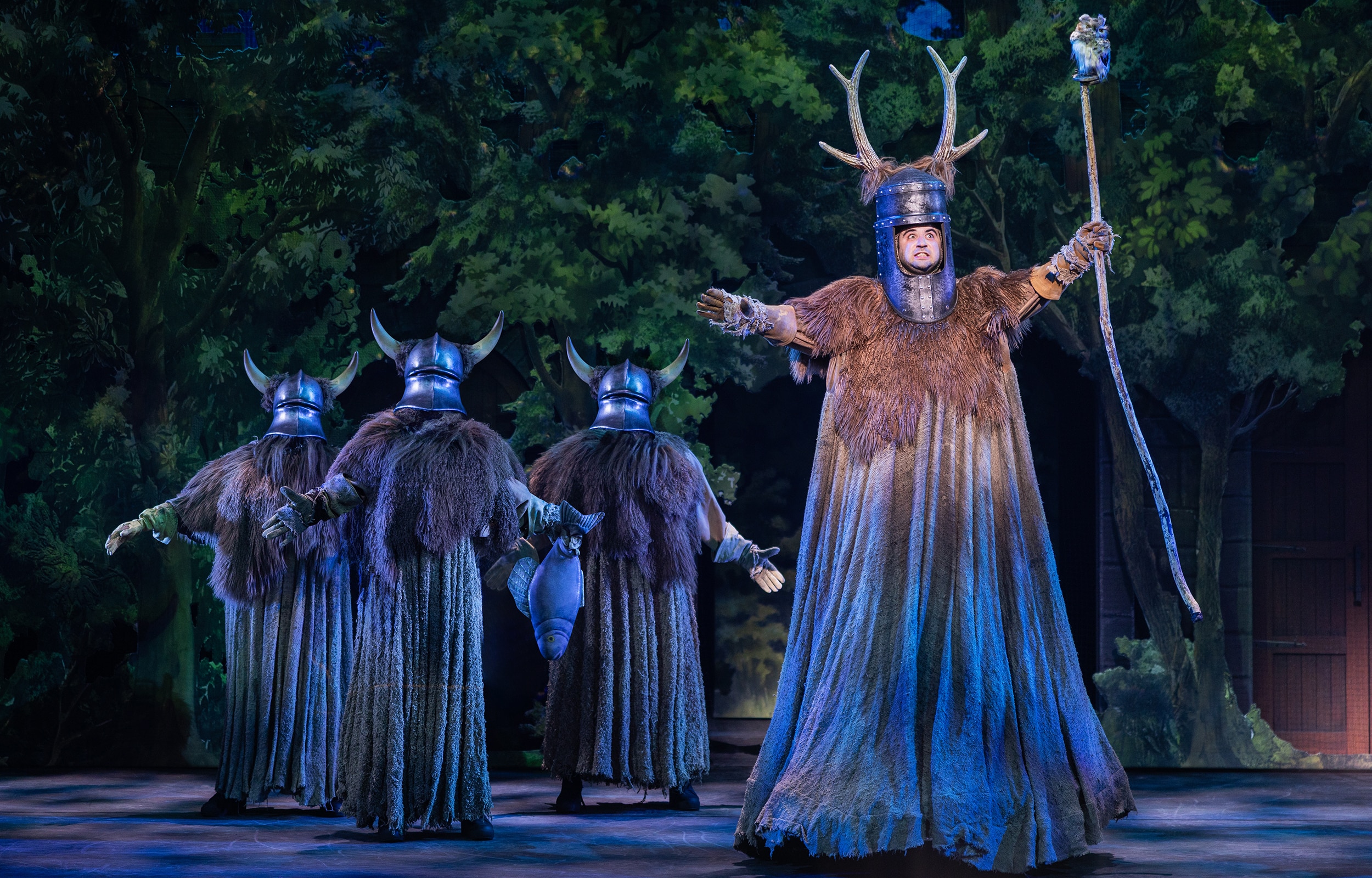
Chris Collins-Pisano and Ensemble in the North American tour of Spamalot. Photo by Matthew Murphy and Evan Zimmerman
From a directorial standpoint, that nonstop hilarity is also Spamalot’s greatest challenge. “Comedy is a physical sport for an audience,” said Rhodes. “And as funny as this show is — and the jokes just keep delivering — sometimes you can err on delivering too many. ’Cause the audience gets tired; they need a break.”
In order to give audience members a chance to catch their breath, Rhodes relies on what he calls “closing the fence.” When the metaphorical fence is open, actors are free to engage with the audience more directly, to “walk that tightrope of improv” in a way that makes each performance a unique event. But part of Rhodes’ job, he explained, is to decide when the fence needs to swing back shut: “At this point you gotta move on, or we will wear [the audience] out for when we really need them.”
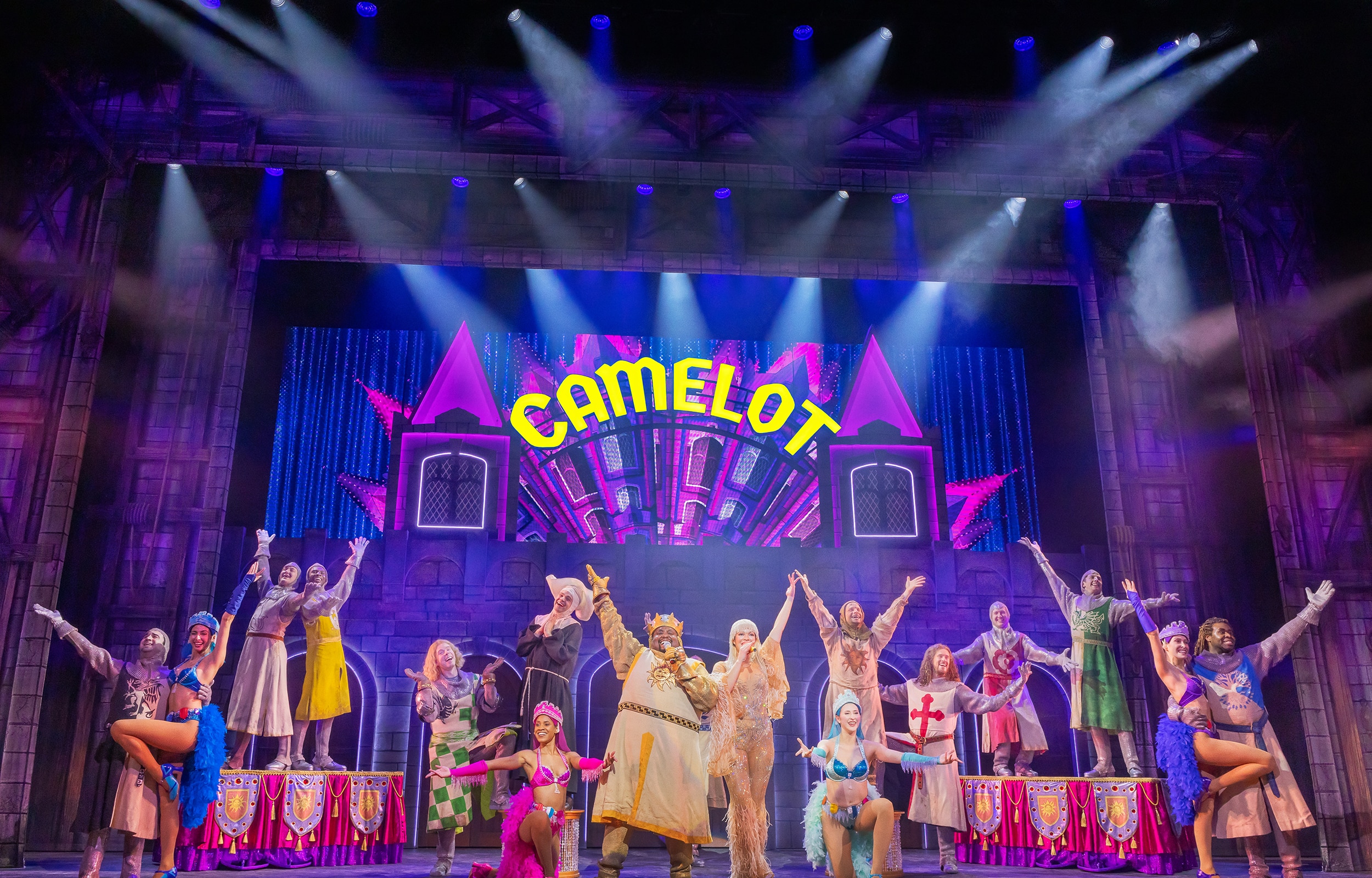
The cast of the North American tour of Spamalot. Photo by Matthew Murphy and Evan Zimmerman
While Spamalot is, in its own words, “lovingly ripped off” from Monty Python and the Holy Grail, Rhodes maintains that the transition from screen to stage has left Python’s satirical wit just as sharp as ever. “What they did with the musical,” said Rhodes, “is they firmly said — in the same way that they say, ‘We love [King] Arthur, but we’re going to make fun of him’ — we love musicals, but we’re also gonna make fun of them.” The delight the show takes in poking fun at musical theater is on full display in numbers like “The Song That Goes Like This,” “You Won’t Succeed on Broadway,” and “Diva’s Lament,” all of which showcase the creators’ deep appreciation of the art form. “I think in order to make fun of something you have to really have a love for what it wants to be,” said Rhodes.
Between the show’s good-natured mockery of King Arthur’s court and its elevation of politically minded peasants, Rhodes also sees a certain democratic optimism running throughout Spamalot. “They’re very democratic,” he said of the Pythons. “I think the reason they drill away at making fun of our political leaders is that they believe in the masses.”
Laughter, tap dance, democracy — if it sounds too good to be true, that’s because it is. For like an invading army hidden inside a Trojan Rabbit, there is still one shocking secret to be revealed: Josh Rhodes, director of Spamalot, has never tried the titular canned meat product.
“People give it to me all the time,” he lamented. “I’m now Mr. Spam, so people think I want it. And I’m like, ‘I love Spam, but I don’t really want to eat it.’”
The Denver Center for the Performing Arts (DCPA) NewsCenter is the organization’s editorial platform for stories, announcements, interviews, and coverage of theatre and cultural programming in Colorado. We are committed to producing accurate, trustworthy, clearly sourced journalism that reflects our mission and serves our community.