DCPA NEWS CENTER
Enjoy the best stories and perspectives from the theatre world today.

When Lisa Orzolek first began working as the second scenic assistant at the Denver Center for the Performing Arts in 1992, the Theatre Company was producing The Grapes of Wrath based on John Steinbeck’s novel about the Joads of Oklahoma, forced to migrate west by a convergence of Depression Era economics and environmentally wrought disaster.
“Our production was amazing,” recounts Orzolek who, over the next three decades, rose from that scrappy entry position to Director of Scenic Design, a title she’s held since 2013. “There was a turntable. There was a truck that drove on stage. There was a river. There was rain. It was amazing,” she repeats, with a wistful smile, wonder still suffusing her admiration more than three decades later. “It was so stunning. And it really supported the story.”
On a morning last December, Orzolek took time to pull back the curtain on how she and her team support shows that, well, don’t have traditional curtains. As she sat in the Denver Center Theatre Company’s design studio (a large but surprisingly warm space, thanks to some lighting choices she and Charles MacLeod insisted upon), four productions were in different phases on the way to their opening nights in the Helen Bonfils Theatre Complex.
The drawings for the set of Godspeed, a western set shortly after the end of the Civil War, had been sent to the shop for construction. The team was beginning work on the musical Next to Normal in the studio. Orzolek was also coordinating meetings with the scenic designers of the Pulitzer Prize-winning drama English — about an anxious group of Iranian adults studying English in Tehran—and the Puerto Rican family drama Somewhere, which heralds the return of the Tony-winning playwright Matthew Lopez (The Legend of Georgia McBride) to the DCPA stage.
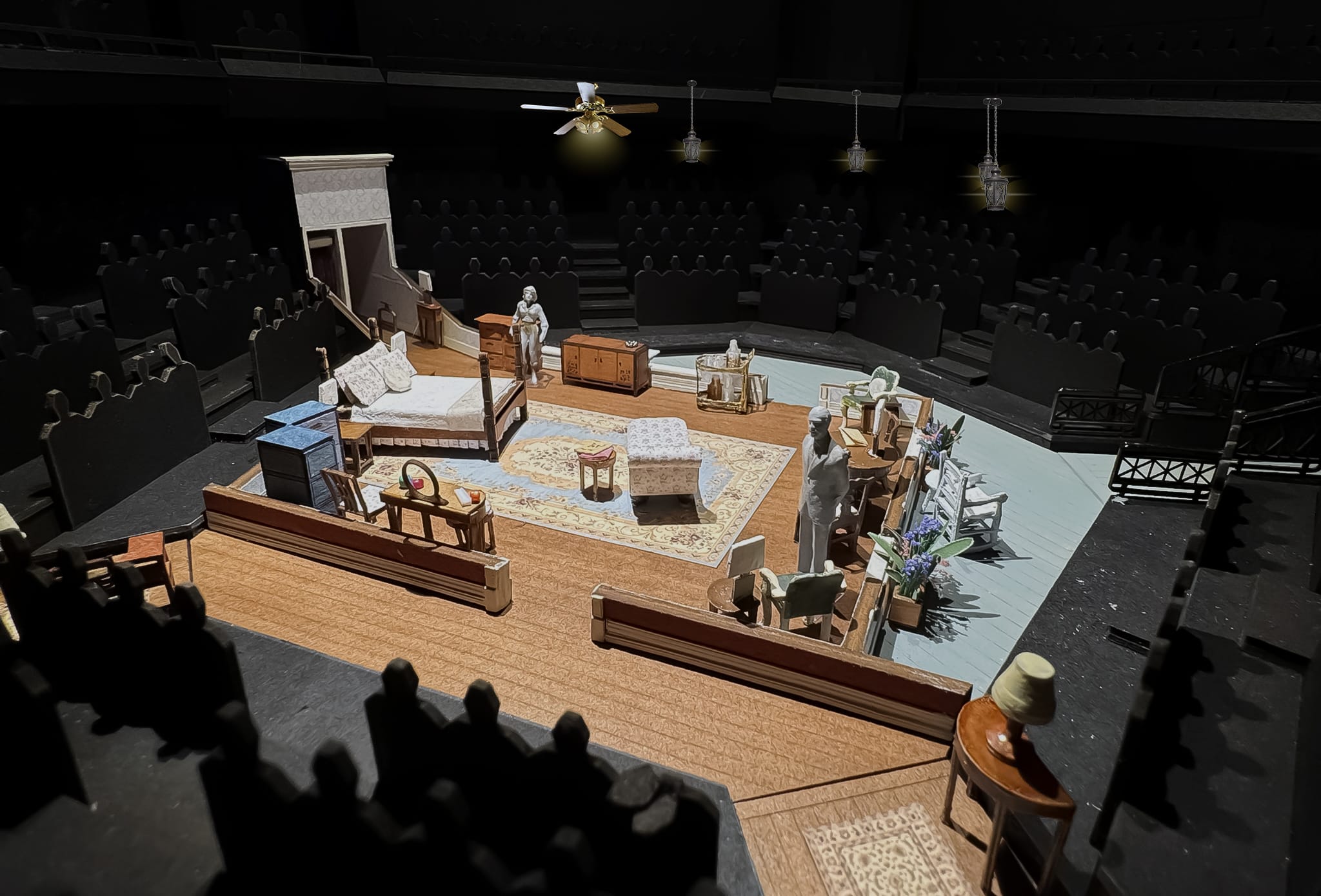
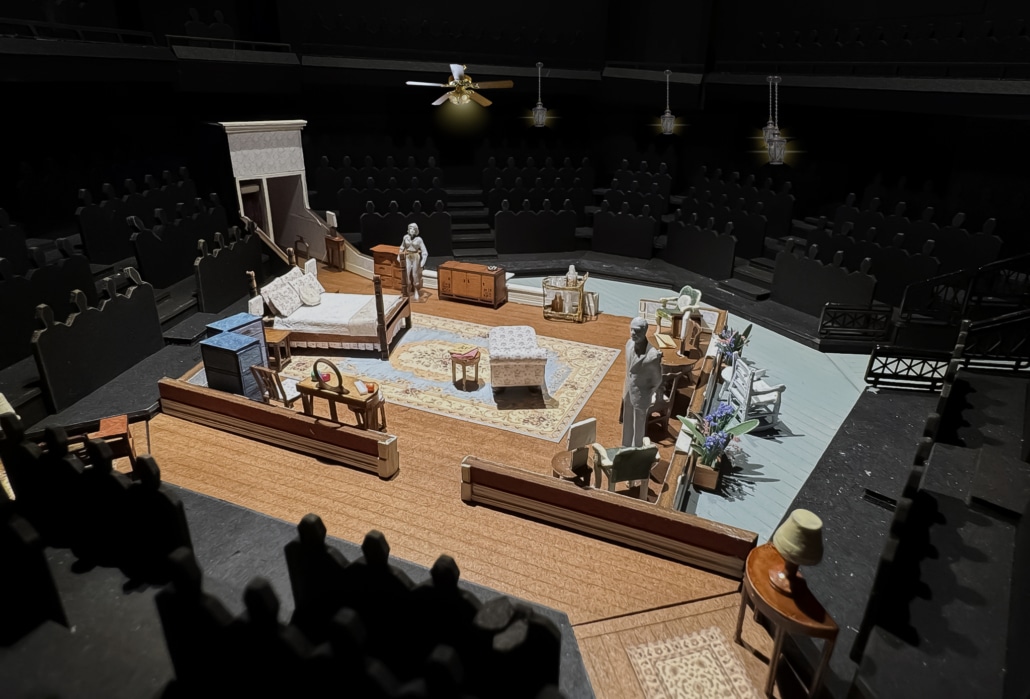
Scenic design for Cat on a Hot Tin Roof.
Orzolek’s appreciation for Theatre Company’s scenic wizardry will resonate with patrons. Over its nearly five decades, the Denver Center has become the envy of other regional theatres for its shops, its craftspeople, its resources and is applauded by visiting theatre-makers for its collaborative spirit and expertise.
But as a lover of theatre, she also champions its elemental material: language. There’s a part two to her Grapes of Wrath anecdote. “I had just come from a theatre in California in which the graduate students had done a production with rehearsal blocks and platforms in the rehearsal room. And it was equally as compelling,” she recalls.
“One of the things that we learn in the [Colorado New Play] Summit, I think, is that it’s the words,” she says, nodding to the Denver Center’s annual event in which working plays are — well “read” doesn’t quite do justice to the engaging weekend of staged readings.
“I love details. But then I want it to just go away. Once the actors come on stage, I just want the actors to embody the space. Then the audience doesn’t think any more about the set, what is there is in the background.” — Lisa Orzolek, Director of Scenic Design
Sets do — but also don’t quite—recede in the theatergoer’s attention. The best hold, amplify, transform. Orzolek shares a few that have stayed with her. There was Gee’s Bend by Elyzabeth Gregory Wilder, about the African American quilting traditions of an Alabama River village community. (“We created a river. We baptized someone on stage.”) There was One Night in Miami, Kemp Powers’ fictional retelling of the historic gathering of Malcolm X, Muhammad Ali, Jim Brown and Sam Cooke after the boxer defeated then heavy-weight champion Sonny Liston. (“That was a great script, and just working with that team was one of those experiences I will remember for a long time.”)
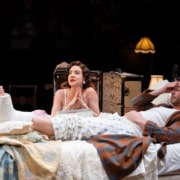

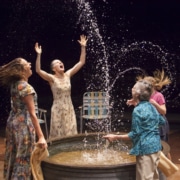
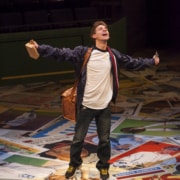
The two dramas have something in common: they were staged in the round. (“I do like to do those stories where the audience is so close”). The upcoming world premiere of Godspeed, a revenge saga written by Terence Anthony, will also unfold in the round of the Kilstrom Theatre (previews begin Jan. 30).
Westerns are a notoriously cinematic genre, so a play teasing the genre would seem to beg for video projections to ground the action in the vastness of the West. The play’s director, Delicia Turner Sonnenberg, wanted to avoid that default and, incidentally, the Kilstrom resists that too easy solution. So how will the play follow its titular and avenging hero as she journeys from Mexico back to the Texas plantation where she had been enslaved?
“One of the ways that journey plays work and you can feel the passage of time and different environments is using a turntable. So, we have a turntable in the center with a donut revolve around it. You will be able to have objects going in one direction and objects going in the opposite direction. You really will feel that we’re going apart from each other.” — Lisa Orzolek on traversing time and place in Godspeed
The set will lean into nature, too. “We haven’t done a naturalistic sort of environment in a minute here at the Denver Center. So that’s super exciting,” she says. “We’re carving and layering stuff to get dirt, mounds and mud, and there’s some foliage, a tree. It’s pretty exciting.”
Orzolek has been providing support to the play’s scenic designer, Tanya Orellana. Different designers need different things from the studio, she says. “With Tanya, she specifically needed us to take the ideas that were in the model form and get those translated into paper so the shops can build from that.”
The morning Orzolek sat down to talk, she was also at work on one other project. (Because four shows aren’t enough to juggle?) She’s aiding scenic designer Neil Patel in the mounting of Theater of the Mind for Chicago’s Goodman Theatre. Nurtured and produced by the Denver Center and its experimental storytelling whiz Charlie Miller at Off-Center (shuttered in the fall), David Byrne and Mala Gaonkar’s immersive work about memory — personal and collective — and neuroscience had its world premiere in 2022 in a converted warehouse space in Denver York Street Yards complex.
Now the show is being loaded into a seven-story building in Chicago’s Loop. “I have the joy of fitting the concept of it into a different space,” she says, without a hint of snark. Orzolek likes problem-solving. Which invites a question: “Creating from the get-go or problem-solving, which part of your brain is your favorite?”
“You know, I think mine work in tandem,” she replies. “I love problem solving. I love that I get a script and the playwright has given you all this great description and you can envision it. And then you’re told…we’re gonna do it in the round.”
“Huh.” She’ll think.
The wry smile of the savvy veteran dances at the corners of her mouth — and then Orzolek, her design staff, and a show’s artistic team get to work.
 ©Denver Center for the Performing Arts