DCPA NEWS CENTER
Enjoy the best stories and perspectives from the theatre world today.

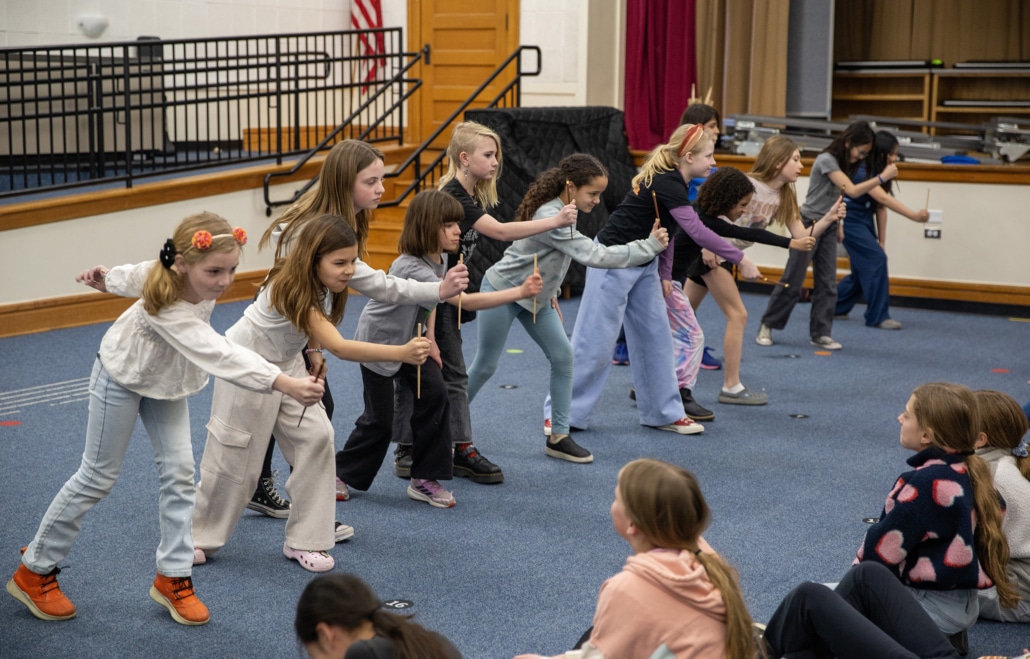
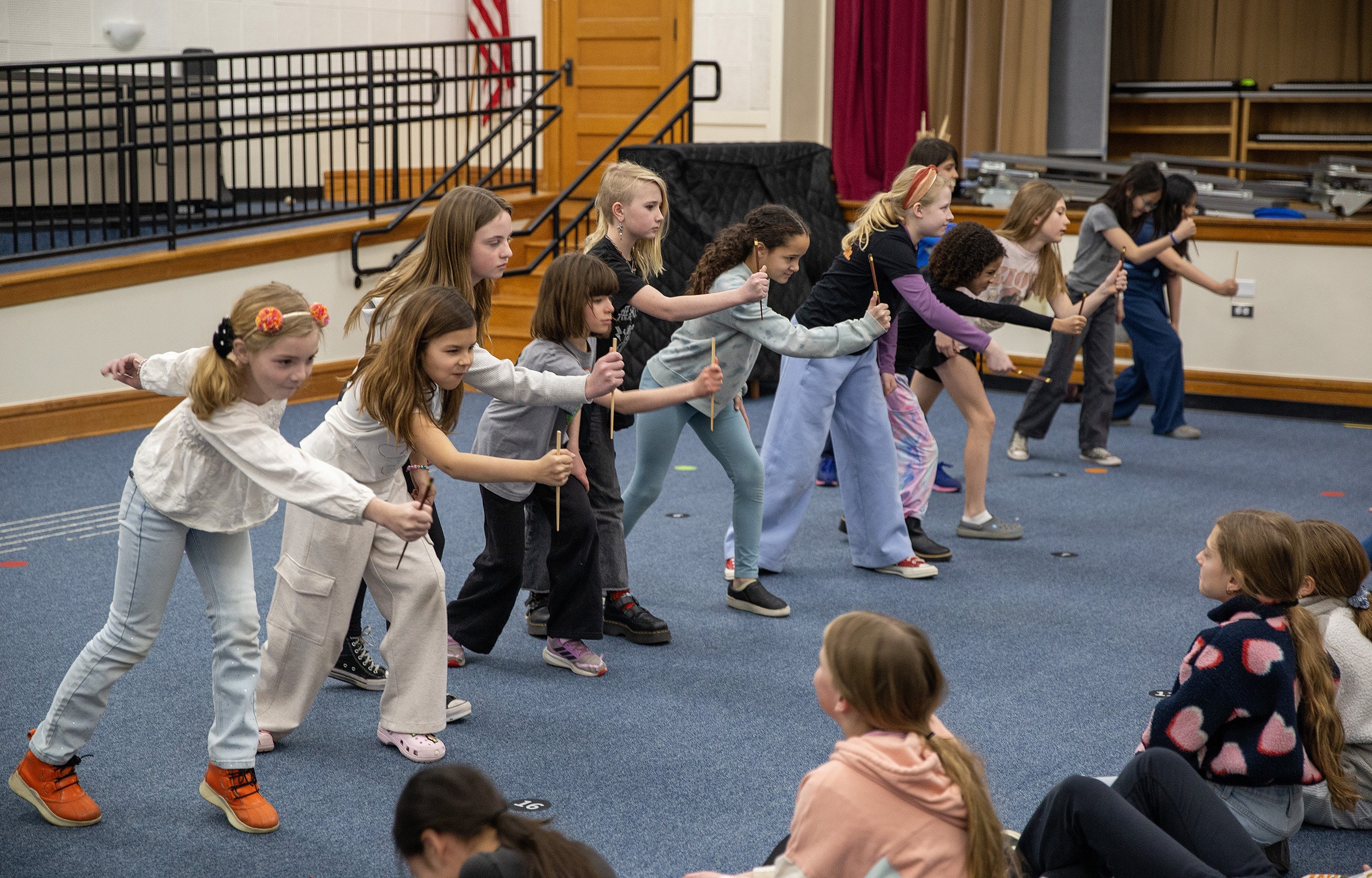
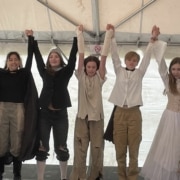
Polaris Elementary School students participate in a preparatory workshop for the DPS Shakespeare Festival
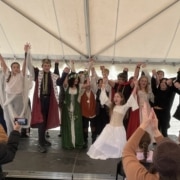
It was morning on April 24, and the Denver Performing Arts Complex was packed with witches, queens, kings, maids topped with wreaths of flowers, capes and pantaloons.
The students from my school, Polaris Elementary? Well, instead of Elizabethan costumes, our fourth and fifth-graders were dressed to perform Julius Caesar in kid-sized C-suite suits, camo fatigues, red smoking jackets, and the fleece pullovers of 21st-century finance bros – all part of our modern take. Siggi’s black business suit was partly obscured by a Snow White dwarf backpack; Bea’s Julius Caesar wore a green velvet Tyrolean hat that her great-grandfather once owned.
They were among more than 5,000 elementary, middle and high school students gearing up to perform at the 42nd annual Denver Public Schools’ Shakespeare Festival. Stages lined the breezeway, Sculpture Park and even the landings of the parking garage. After five months of rehearsals, Odella and Maya were giggling and batting away at each other with rubber daggers while Alden’s eyes grew wide at the sight of the churro stand.
Students devoted each Monday afternoon since November, and an hour each Friday since February, not just rehearsing Julius Caesar, but also learning what it meant to be part of a company of actors. This time, they weren’t going it alone. In addition to our music and drama teacher, Corrilee Kielmeyer, and me as her assistant, we were benefitting from the acumen of a theater professional. Each year, the Denver Center for the Performing Arts (DCPA) sends educators to work with area schools, deepening their understanding of Shakespeare and the elements of performance. We had our first contact in August from Sam Wood, the Denver Center’s Director of Education and Curriculum Development. Sam gave Polaris students lessons in language, character, stage combat, blocking, and conducted the production’s preview two weeks before the festival.
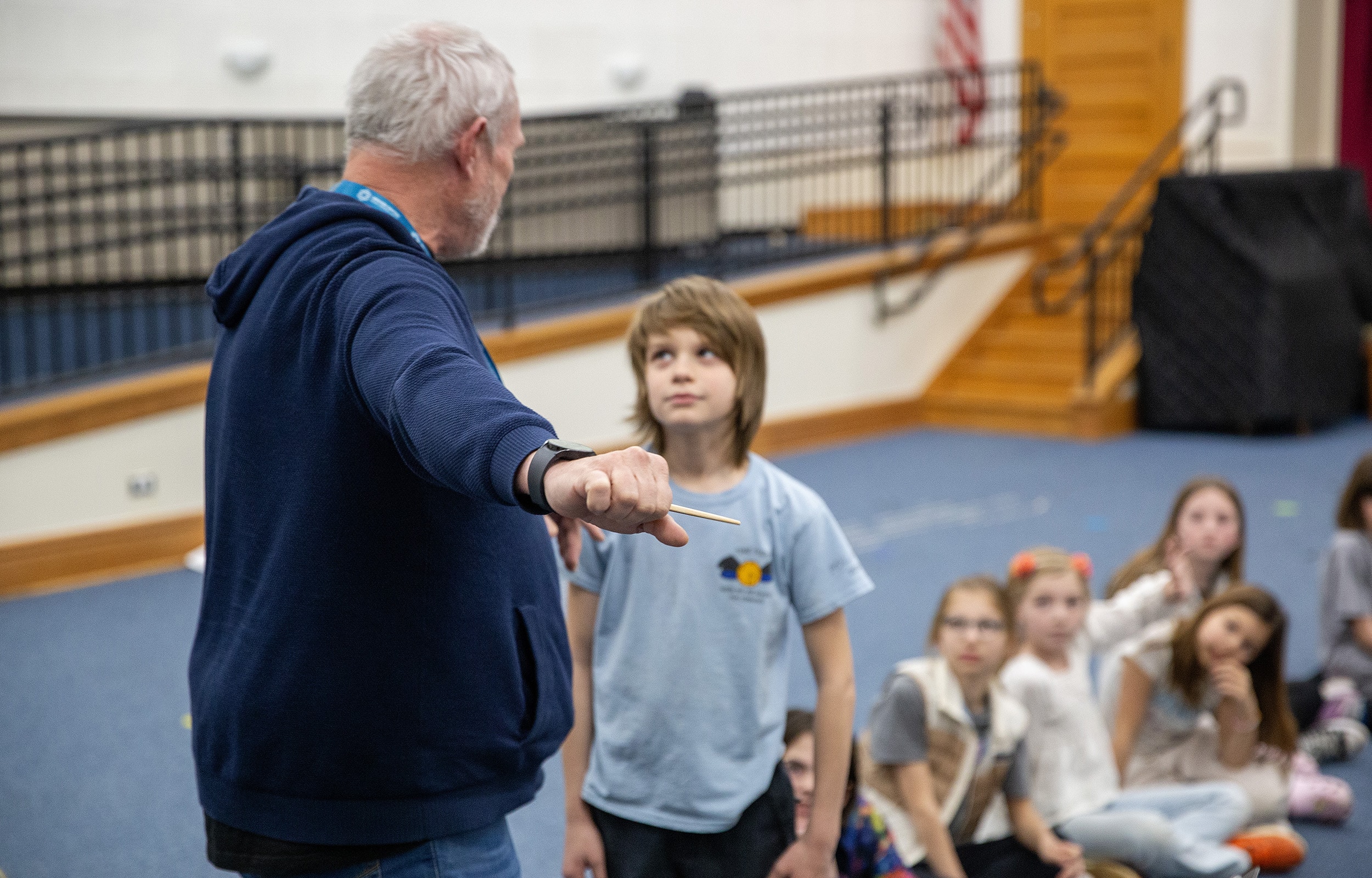
Director of DCPA Education Sam Wood leads a DPS Shakespeare Festival workshop at Polaris Elementary
Early in December, Sam made his first visit to Polaris, introducing students to iambic pentameter, free verse, and couplets: the building blocks of Shakespearean language. At the end of January, he returned to students eager to experience his infectious energy and positive but firm leadership. To warm them up for character work, he delivered his opening instructions: “Your first job is just to walk around the space, and don’t follow each other, go everywhere. I’m going to give you a prompt, and when I call it out, you’ll immediately go make that prompt. I’m going to call ‘Julius Caesar,’ and you’ll go stand like a colossus.”
Sure enough, four-foot Zoe in her dress suddenly stood astride the auditorium like a colossus – a power she brought to the stage four months later as Brutus. Sam continued to give students scenarios, simultaneously teaching them the meanings behind the moments in the play. With no parts cast yet, students were trying everything on to see what fit.
“Vocal choice can be loud, it can be soft, it can be sing-songy, it can be flat. Why would we make different vocal choices?” Sam asked the students.
“To portray the character’s emotions?” a fifth-grader answered.
“On the count of 3, show me that you are super bored,” Sam soon added. Shoulders slumped, eyes glazed, no one made eye contact.
“So emotional becomes physical, right? And it can become vocal,” Sam continued. “Shakespeare gives you really great lines that can help you find the character: ‘Friends, Romans, Countrymen.’”
Teagan took a try, spreading their hands like an orator.
Sam told the students to find a spot on the wall where they could speak to their crowd. It’s like a Broncos game, he said – but with no microphones. He called up Savannah, a quiet-voiced fifth-grader.
“Why me?” she asked plaintively.
“Because you did it so well,” Sam answered, and flipped the switch that led to Savannah building in intensity, with a bellow on the word “countrymen.”
Rehearsal moved into other classic lines, including Caesar’s final words, “Et tu Brute?” “There’s an amazing amount of T’s, and he’s dying so he doesn’t have his breath. It’s been hundreds of years, and Shakespeare is still directing you because he wrote it that way,” Sam said. “Look at your best friend. It’s your best friend who did the final stab, and you can’t believe he stabbed you.”
Kids looked to their friends and giggled.
“That’s called breaking character, and we don’t want to break character,” Sam said. “Does anyone know how many people came to the festival last year? Five thousand people came. So, you’re gonna have to really talk, even though you’re dying.”
A month later, Sam returned to teach stage combat and wrote two column headings on the whiteboard: Safety. Consent.
“There’s also a moment before the movement starts where you look your partner in the eye, and there’s a nonverbal consent that they’re ready to go,” — Sam Wood, DCPA Director of Education & Curriculum Development
He paired off the students, and they practiced fighting in slow-motion, sure to get the consent from their partners’ eyes first. They learned to twist an arm without really twisting it, to plunge a dagger with their back to the audience, blocking the view of the non-penetrating weapon.
With 10-year-old Galen’s consent, Sam buried his fingers in the student’s waving hair, pretending to pull him by the hair. Galen, as directed, put his hands on top of Sam’s, controlling the action as Sam yelled, “Young man, you’re going to the office!”
“He’s completely in charge,” Sam explained. “I’m not pulling him anywhere. I’m going to go wherever he goes.”
The students erupted in screams of laughter.
“I saw a lot of smiles,” Sam said. “If someone was pulling my hair that hard, I wouldn’t be smiling. I need to see some pain.”
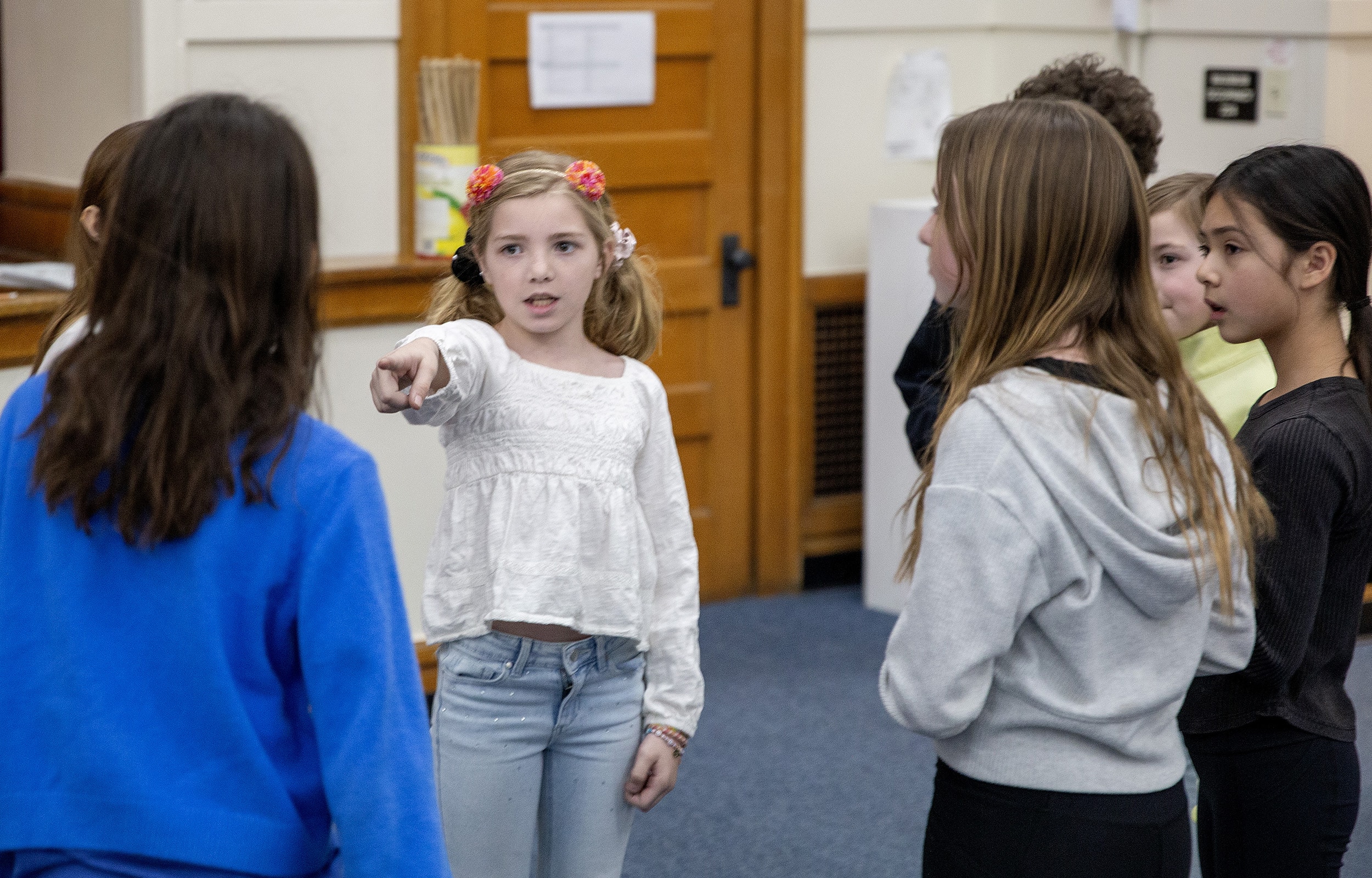
Polaris Elementary School students participate in a preparatory workshop for the DPS Shakespeare Festival
By the first of March, the play was cast and students were rehearsing their lines. Some monologues verged on five minutes, and it required a lot of outside dedication to commit the words to memory. With a cast of 33 and 11 scenes to rehearse, Corrilee and I split up the students most days, breaking down the language line by line and feeling shocked by how little explaining the students needed. Intuitively, they got it.
Sam came back, this time to tweak our blocking of the scenes, particularly focusing on Act III, Scene 1: the death of Caesar. “Caesar, you are doing an amazing job,” he told Bea. “Could you add a couple laughs, like, my wife’s just been dreaming about blood?”
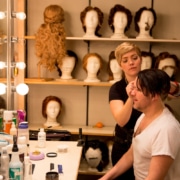
The final visit from Sam was the preview, which began with five second- to fifth-graders performing as members of the Polaris string ensemble. After the performance, Sam returned copious notes with detailed feedback for the students, always praising their successes while gently nudging them further. Those notes were absorbed for the dress rehearsal, five days before the festival, and in front of parents. Valentina, who barely spoke with a whisper in fourth grade, was back this year loud, clear and with intention. While waiting to go on, a soothsayer braided Brutus’ hair in the wings. Naia looked like she just got home from Desert Storm, while India, a delicate ballerina, delivered a blistering tirade in the final scene.
They were ready to take their bows.
Lisa Bornstein was the former Theatre Critic of the Rocky Mountain News (1999-2009) and is now a fourth grade math teacher at Polaris Elementary School.
The Denver Center for the Performing Arts (DCPA) NewsCenter is the organization’s editorial platform for stories, announcements, interviews, and coverage of theatre and cultural programming in Colorado. We are committed to producing accurate, trustworthy, clearly sourced journalism that reflects our mission and serves our community.