DCPA NEWS CENTER
Enjoy the best stories and perspectives from the theatre world today.

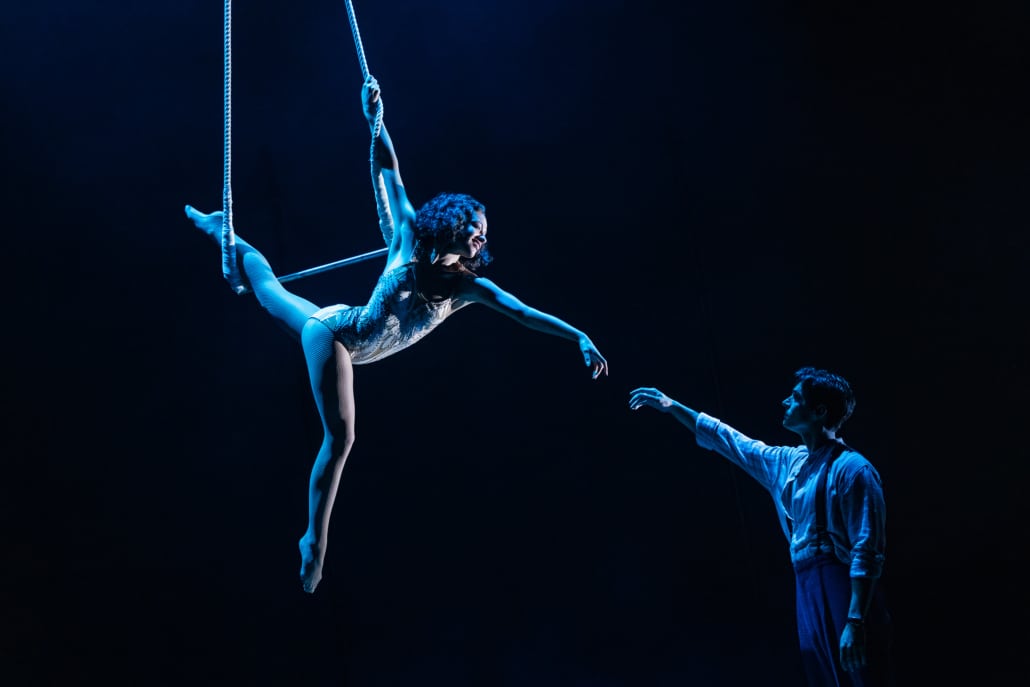
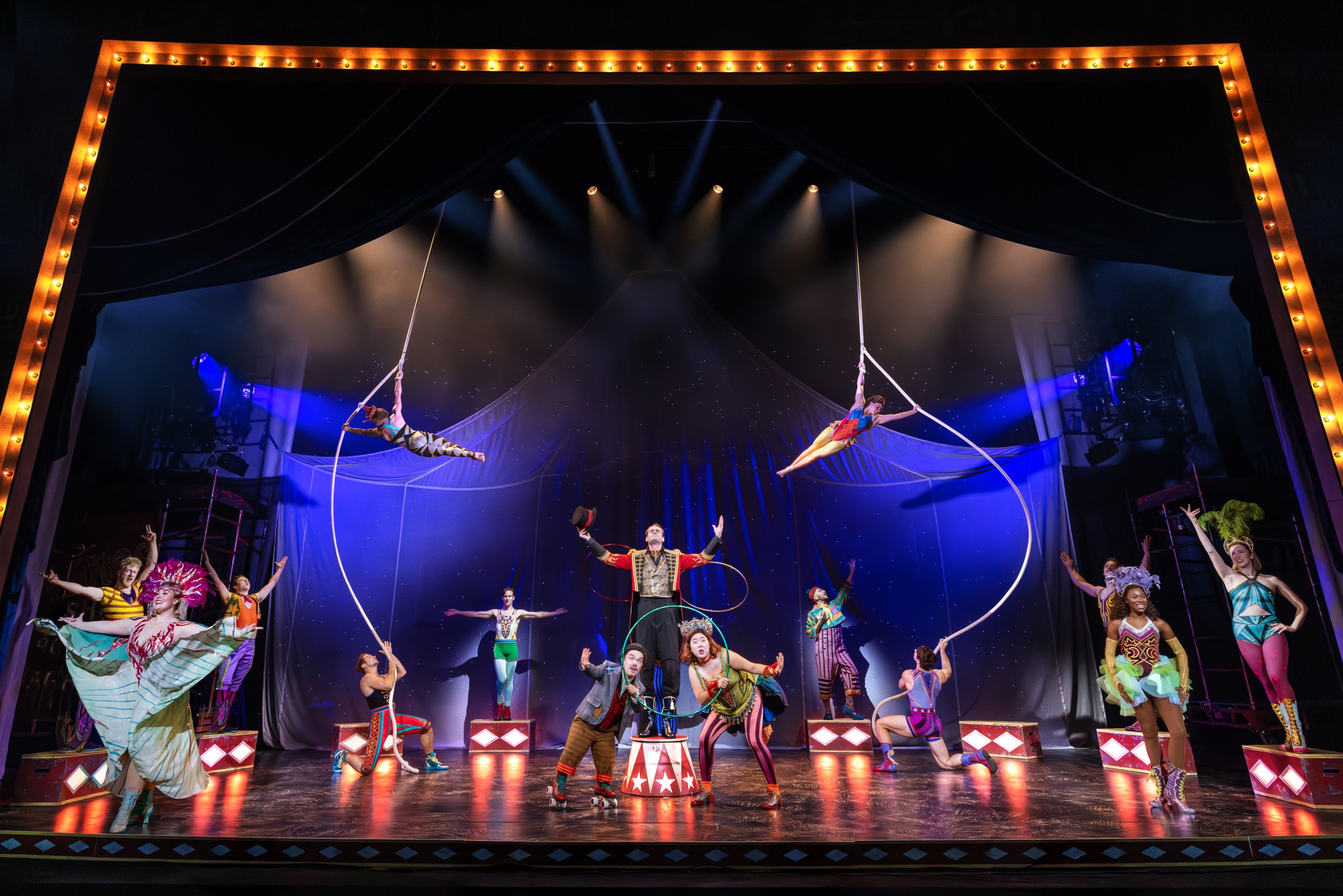
The cast of Water for Elephants. Photo by Matthew Murphy for MurphyMade
Most musicals are two-dimensional. That’s not a put-down; it’s a spatial reality. Stages are two-dimensional surfaces, and the actors who travel them are typically limited to two degrees of freedom: they can move upstage or downstage, stage right or stage left. A notable exception is if the show in question also happens to be a circus. Then the actors are welcome to fly.
From the trapeze to the tightrope, Water for Elephants is emphatically three-dimensional. But accessing what circus designer and co-choreographer Shana Carroll calls “real estate in the air” isn’t just an artistic challenge — it’s also an engineering one.
“It’s a lot of geometry,” says Carroll, describing the network of pulleys, wires, and slings whose sheer complexity occasionally brought rehearsal to a screeching halt. Countless hours were spent troubleshooting and reconfiguring. “We did not make our lives easy,” Carroll admits. “We do things on the stage that are kind of crazy to do, rigging-wise.”
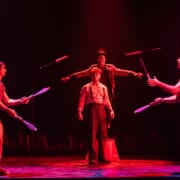
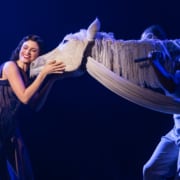
In addition to behind-the-scenes headaches, this complexity delivers some remarkable feats of showmanship. Carroll points to the moment when the cast raises the center pole of the Benzini Brothers’ circus tent; what would normally take 30 minutes of pre-show preparation, the cast accomplishes with real-time choreography.
Much like pitching a big top, choreographing Water for Elephants was a team effort. When Jesse Robb joined the project as a co-choreographer, it marked the start of a collaboration that he and Carroll fondly refer to as their “arranged marriage.” The two soon found that their experiences working for Cirque du Soleil allowed them to develop a common movement language, one that evolves over the course of the show.
Robb describes the show’s early choreography as “very utilitarian,” a reflection of the intense physical labor that a circus requires of all its members. But as protagonist Jacob Jankowski begins to acclimate to life on the road, the choreography gradually takes on the unabashed spectacle of Depression-era circus. “You get a little bit further into act one,” says Robb, “and you’re looking at very Broadway-esque moments in [‘The Lion Has Got No Teeth’]. And then ‘The Grand Spec’ at the end of act one, the language is very much old-school presentational circus. So the choreographic language changes dramatically throughout the show.”
For Carroll, a former trapeze artist, this combination of 1930s old-school circus and modern-day artistry is a major part of the show’s appeal. As a veteran of several traditional circuses, she enjoys recalling her horseback entrances and the onstage poker games she played against an elephant.
“I love the artsy theatrical circus that I now do, but I really have so much reverence for the roots.… And marrying them — doing in a traditional context some of the newer contemporary language — is really satisfying for me, because I actually don’t like when it’s so delineated.” — Shana Carroll, Co-Choreographer of Water for Elephants
The importance of unspoken physical language is a theme that Carroll and Robb return to frequently. And when building out such a language, it helps to have what Carroll calls “that little glossary in your head,” a way to find the right pairings of physical movement with an emotional moment.
Through the risks they entail and the images they create, different circus techniques lend themselves to different metaphors. Aerial taps into freedom and liberation. Ground acrobatics calls to mind community and interdependence. Three-high stacking evokes a sense of victory — or at least it always has to Carroll, who at one point in the process found herself needing to revise her personal glossary.
During the show’s development, director Jessica Stone wanted to employ three-high stacking to depict the practice of red-lighting, in which Benzini employees are hurled from a moving train when their services are no longer required. But to Carroll, the violence of red-lighting clashed with her understanding of the three-high stack as a victorious, uplifting image. Eventually, however, she came to realize that, “oh no, if we make it about danger and about the risk and the stakes, we can change that imagery.”
This kind of collaboration, cross-pollination, and flexibility is nowhere more evident than in the show’s cast. Most circus performers are specialists in a particular discipline such as tumbling or juggling. But in the case of Water for Elephants, the show’s relatively small cast — there are only seven dedicated circus performers — means that versatility is at a premium. As a result, the artistic team was constantly on the lookout for what Carroll calls “unicorns,” performers who could not only soar on a trapeze but could juggle a knife and tumble as well.
While the Benzini Brothers are fictional, the most successful real-life circus of the 1930s — Ringling Bros. and Barnum & Bailey — is still around today, preparing to kick off a new tour in 2026. For Robb, the enduring appeal of the circus has a simple and personal explanation: “I know my impetus [in becoming an artist] was wanting to run away to Cirque du Soleil when I was 20 years old, and it was the idea of finding a community of like-minded people.”
The way Carroll sees it, the power of circus comes back to mechanics. “If five people are doing a trick and two people are throwing and one person’s catching, [you can’t ignore] the trust and the fact if one person doesn’t do their job, someone dies. It really is just the most profound way of showing interconnectivity and interdependence.”
DETAILS
Water for Elephants
Feb 11-22 • Buell Theatre
Tickets