DCPA NEWS CENTER
Enjoy the best stories and perspectives from the theatre world today.


By Chris Coleman, Denver Center Theatre Company Artistic Director
Whether it’s Hamilton or Hamlet, every play started as a new work. Someone was excited by a story and brought together a group of collaborators to carve out a path toward opening night. It’s always a risky venture. Ask anyone in our industry and you’ll find that the synonym of “theatre” is “risk” — a word that is at once terrifying and exhilarating because to remain relevant and attract new audiences, theatre must evolve.
That’s where new play development comes in.
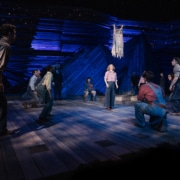
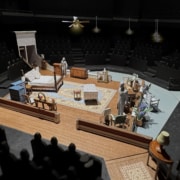
The Denver Center Theatre Company (DCTC) has been producing world premieres since its inception in 1979, and that thread has become part of our DNA. For the last 20 years, our Colorado New Play Summit has been the primary vehicle through which we develop new plays.
First, we choose a story that excites us — is there something fresh about the way the story is told? Is it timely? Does it have a connection to this part of the country? Would producing this piece help us foster a relationship with a particular community?
Then, we consider scale and budgetary demands.
Finally, we ask ourselves, “Can we imagine producing this piece?”
Ultimately, we select four scripts to be read in the Summit alongside two fully produced world premieres.
The readings give a playwright the time, resources, and audience to determine if the story in their imagination is — or is not — landing. Each playwright also is assigned a dramaturg, a structural expert who helps refine what the writer has developed and unlock key issues the writer may face.
Another crucial piece in new play development is the commission. It’s extremely challenging to make a living as a playwright in the U.S., so commissions are a way to provide time — the time to sit, think, imagine, and write. For DCTC, commissions are also a way to build relationships with writers and have a future stake in their work should it prove promising.
Over the years, we’ve had a number of projects move from Denver to national stages. We’ve presented 215 readings and 193 world premieres of which 90 have gone on to 553 subsequent productions on professional stages. While the success of a world premiere can, in part, be measured by ticket sales, which is always fun when it happens, audience response, industry interest, and future productions also measure success.
While the rewards can be great, new play development remains a risk. I’m often asked why — why do we invest in new works? Contemporary writers spin stories that “hold as ’twere the mirror up to nature”. They help us experience something about our culture, about ourselves that we may not have been connected to before.
And that’s the juice.


 ©Denver Center for the Performing Arts